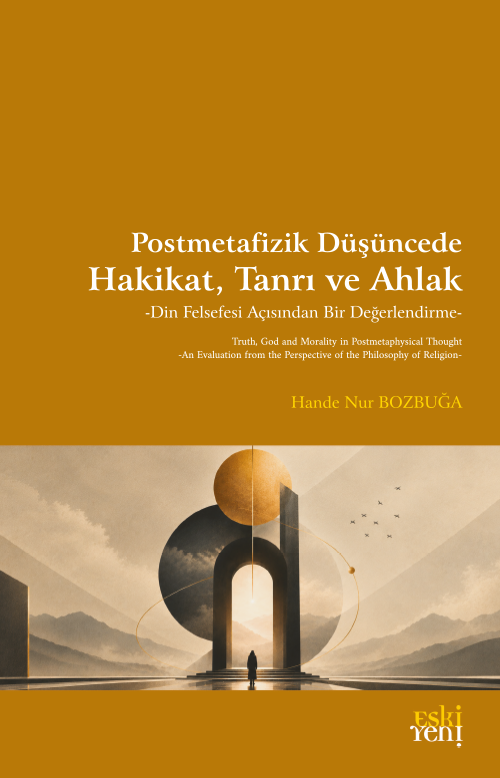
Truth, God and Morality in Postmetaphysical Thought
-An Evaluation from the Perspective of the Philosophy of
Religion-
This study examines how questions of God, truth, and morality
are reconsidered within the postmetaphysical context, in which
the transcendent, immutable, and foundational claims of metaphysical
thought are called into question. Its primary aim is to
reveal the possibilities and limits of postmetaphysical philosophy
of religion by evaluating Gianni Vattimo’s “weak thought”
and John D. Caputo’s “weak theology” from a comparative and
critical perspective. Within this framework, the transformation
of the metaphysical conception of God, the interpretive nature
of truth, moral responsibility, and the problem of evil are examined.
Vattimo’s weakening of the metaphysical conception of
being and his reinterpretation of Christianity through kenosis
are considered alongside Caputo’s understanding of God not
primarily as an ontological being, but within the horizon of the
event, the call, and unconditional responsibility. The study argues
that although both approaches open up new possibilities
for religious thought by moving away from metaphysical certainty,
this transformation also gives rise to significant problems
concerning the status of truth, the possibility of speaking about
God, and the normative ground of moral obligation. While acknowledging
the contribution of postmetaphysical thought to
the philosophy of religion, the study critically evaluates the adequacy
of its responses to the philosophical and theological problems
arising from the withdrawal of the metaphysical foundation.
Keywords: Philosophy of Religion; Postmetaphysical Thought;
Weak Thought; Weak Theology; God; Truth; Hermeneutics; Kenosis;
Responsibility

 İÇ SAYFALAR