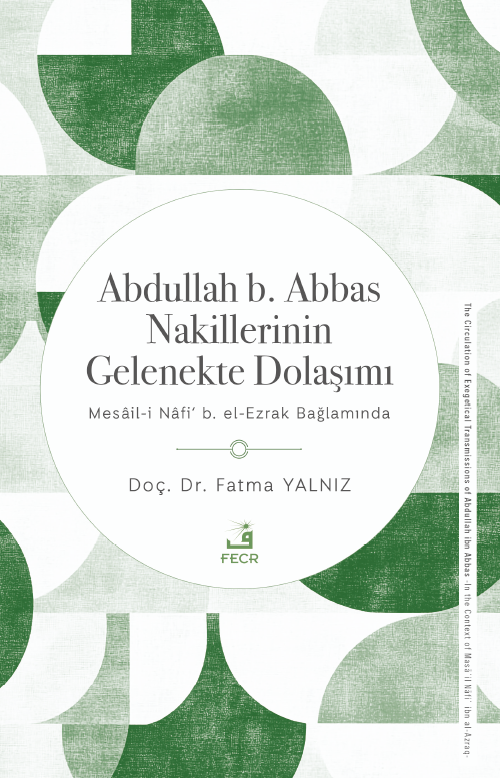
The Circulation of Exegetical Transmissions of Abdullah ibn Abbas
In the Context of Masāʾil Nāfiʿ ibn al-Azraq
This study addresses contemporary critiques directed at the historical reality of
Islamic literature within the framework of the Masail Nafi’ b. al-Azraq, one of the
founding texts of the tafsir (Quranic exegesis) tradition. Consisting of approximately
255 narrations, this collection of dialogues took place between Abdullah b. Abbas,
the cousin of the Prophet (pbuh), and the Kharijite leader Nafi‘ b. al-Azraq. In these
dialogues, rare and obscure words in the Quran (gharib al-Quran) are explained
through the attestation (istishhad) of ancient Arabic poetry—a text that sits at the
very center of modern tafsir debates. Certain modern approaches in the literature
question the authenticity and attribution of the work, arguing that Ibn Abbas was
constructed as a mythical figure, that the text reflects the political legitimacy efforts
of the Abbasids, that it was expanded over time through subsequent interpolations,
and that it is absent from early sources. Conversely, other researchers present the
diversity of chains of transmission (isnad) and the parallels in canonical philological
sources as evidence of the text’s historical validity.
Prepared within the scope of a TÜBİTAK 1002-A project, this book employs a literature
review and content analysis based on qualitative research methods to determine
the circulation of tafsir material within the tradition. In order to comprehensively
account for the tafsir tradition’s unique understanding of information transmission
and written source relations, all data—whether with or without an isnad—have
been specifically analyzed under the concept of ‘narration’ (naql). Accordingly, existing
proposed formulas have been expanded. In this comprehensive, poetry-centered
survey, literature on gharib al-Quran, majaz al-Quran, and ma’ani al-Quran from
the pre-Suyuti period, along with independent exegeses, Arabic dictionaries, and
hadith sources, were examined to map out both the harmonious and elliptical forms
of the narrations quantitatively and qualitatively. As a result of these detailed
investigations, positive numerical data and concrete findings supporting the historical
reality of the text were obtained, demonstrating that the narrations in question
appear—albeit separately—in various canonical works. Furthermore, the study explores
in depth the historical reasons why these data were cited piecemeal in early
sources rather than collectively. All these statistical ratios and qualitative analyses
refute negative claims based on generalized descriptions, revealing the tafsir tradition’s
uniquely robust transmission mechanism and the historical validity of the text.
Keywords: Tafsīr; Gharāʾib al-Qurʾān; Masāʾil Nāfiʿ; Citation of Poetry; Abdullah Ibn
Abbas; Tafsīr; Transmission Tradition; Historical Reality

 İÇ SAYFALAR