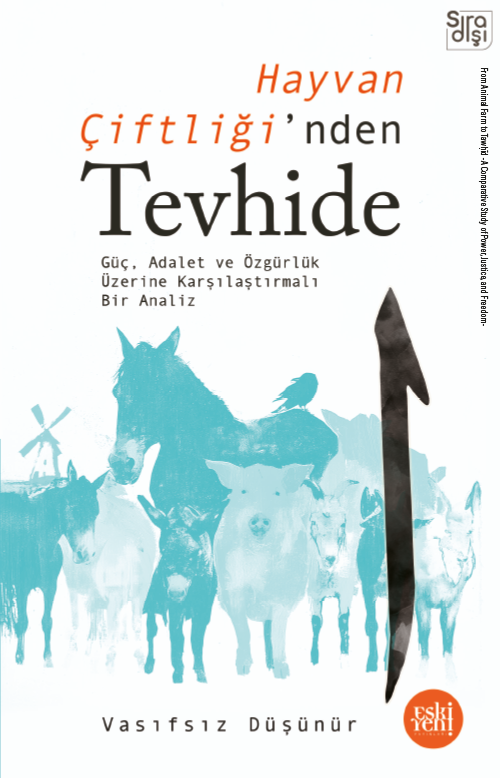
From Animal Farm to Tawḥīd
A Comparative Study of Power, Justice, and Freedom
This study offers a comparative analysis of George Orwell’s
Animal Farm and Ali Shariati’s conception of Tawḥīd as a
framework for social justice and human liberation. The primary
objective is to explore how the concepts of power, justice,
and freedom are interpreted within two distinct intellectual
traditions. While Orwell demonstrates how revolutionary
ideals gradually transform into systems of oppression
and exploitation, Shariati identifies the roots of such corruption
in forms of shirk, namely the absolutization of political
power, wealth, and ideological authority. Through comparisons
such as Napoleon and Pharaoh, the pigs and Qarun,
Squealer and Balaam, and Boxer and the passive masses, the
book examines mechanisms of domination, propaganda,
economic privilege, and social manipulation. It argues that
the pathologies diagnosed by Orwell can be addressed
through Shariati’s understanding of Tawḥīd, which emphasizes
human dignity, social responsibility, and resistance
against all forms of servitude except devotion to God. The
work further evaluates contemporary societies as modern
“Animal Farms,” shaped by media control, consumer culture,
and ideological manipulation. The concluding chapter proposes
a “Conscious Tawḥīd Theory” as a philosophy of freedom
and awareness. Ultimately, the book seeks to establish
an original synthesis between critical political thought and
Islamic perspectives on justice, equality, and liberation.
Keywords: Tawḥīd, George Orwell, Ali Shariati, Power and
Authority, Social Justice

 İÇ SAYFALAR