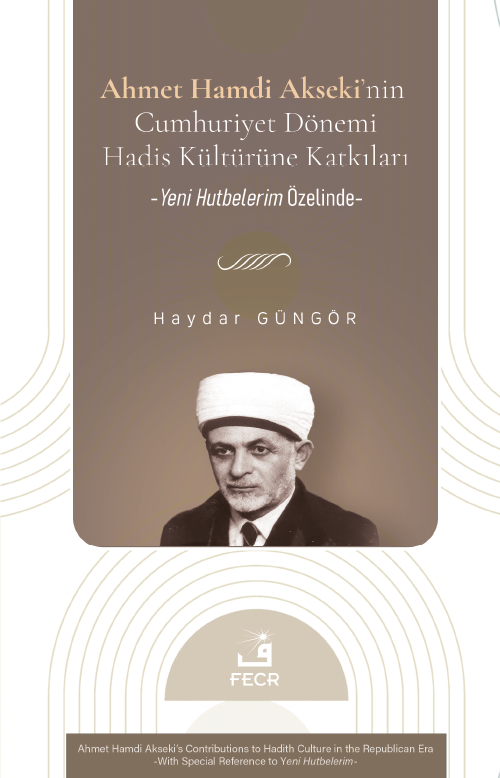
Ahmet Hamdi Akseki’s
Contributions to Hadith Culture in the Republican Era
With Special Reference to Yeni Hutbelerim
Ahmet Hamdi Akseki, who completed his education despite great hardships,
lived through both the Ottoman and Republican eras. While he
received his education during the Ottoman period, he rendered his
primary services during the Republican era. Akseki, who passed away
while serving as the third President of Religious Affairs, largely dedicated
his life to religious services. By authoring works that appealed to all
segments of society, he made significant contributions to the dissemination
of religious knowledge. Religious knowledge acquisition in Turkish
society largely relies on listening. People generally learn such information
through sermons, religious talks, and khutbahs. Taking this situation
into consideration, Rıfat Börekçi, the first President of Religious
Affairs in the Republican era, requested Ahmet Hamdi Akseki to prepare
a khutbah book to be read in mosques. Written upon this official
request, the work entitled Yeni Hutbelerim was distributed to mosques
throughout Türkiye after its completion and was read by religious officials
in Friday khutbah for many years. The work contains a total of 151
khutbah, aiming to inform society both morally and religiously through
these khutbahs. It was intended to increase the public’s knowledge of
hadith through the narrations used in these khutbah. Indeed, while a
significant portion of these hadiths consists of authentic (sahih) narrations,
the work also contains very weak and even fabricated (mawdu)
narrations. This situation has paved the way for the spread of certain
fabricated narrations among the public through the khutbah. It is observed
that some fabricated hadiths, which are still widely used today,
are present in these khutbahs. In this study, after introducing the life
and works of Ahmet Hamdi Akseki, the weak, very weak, and fabricated
hadiths used in his work Yeni Hutbelerim are examined and analyzed.
Keywords: Ahmet Hamdi Akseki; Hadith; Sunnah; Republican Period;
Hadith Culture

 İÇ SAYFALAR