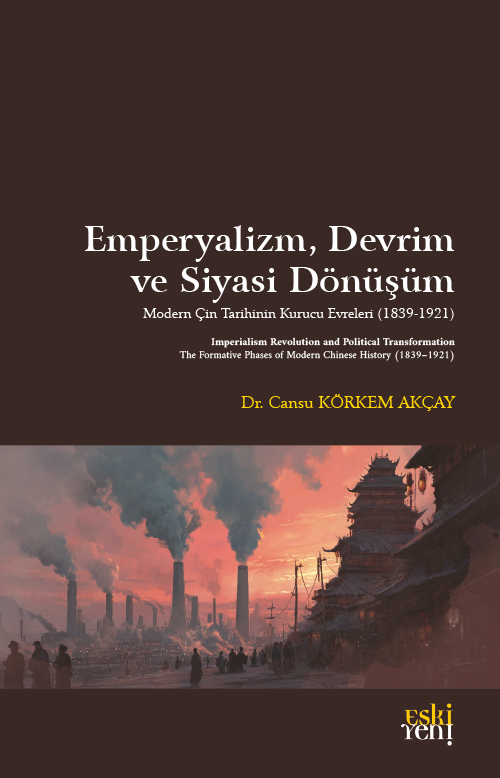
This study examines the foundational phases of modern Chinese history
between 1839 and 1921 through the analytical framework of imperialism,
revolution, and political transformation. China’s historical trajectory
is situated within the broader context of global modernization, with
particular emphasis on the transformation of power relations, evolving
economic structures, and the reconfiguration of international competition
triggered by the Industrial Revolution.
The book is structured around six main chapters. The first chapter addresses
the global transformation initiated by the Industrial Revolution,
focusing on the rise of new centers of power and the evolution of global
economic structures from free trade to financial monopolization, as
well as changing patterns in the distribution of resources and interests.
The second chapter examines the structural vulnerabilities of the Qing
Empire, shaped by the tension between the expansion of overseas trade
and the persistence of a closed, center-oriented worldview, and analyzes
how shifting power balances placed China in an increasingly vulnerable
position. The third chapter explores the expansion of colonial rights
concealed beneath the appearance of free trade, the deepening crisis
following the outbreak of the Opium Wars, and the empire’s search
for self-reform through initiatives such as the Self-Strengthening Movement.
The fourth chapter analyzes the Sino-Japanese War, particularly
naval battles, and evaluates how the failure to grasp the international
conjuncture, ambiguous threat perceptions, and strategic miscalculations
shaped the course of the war and accelerated the collapse of the
Qing order. The fifth chapter focuses on the structural transformation
initiated by the Xinhai Revolution, including republican reforms, efforts
at social transformation, attempts at monarchical restoration, and the
rise of regional military power centers. The final chapter examines the
emergence of democratic consciousness through the New Culture Movement,
the nationwide awakening triggered by the May Fourth Movement,
the founding of the Chinese Communist Party, and the political
and economic crises accompanying the transformation of power.
The central argument of this study is that the transformations of this
period did not unfold as a linear process directed by a single authority.
Rather, they were shaped by the complex and often conflicting interactions
among imperial elites, revolutionary organizations, regional
military powers, Western states, and Japan. The persistent tension between
institutional transformation and social change, as well as the gap
between constitutional principles and everyday practices, constituted a
defining feature of the period.
In this context, the period between 1839 and 1921 should be understood
not as an isolated historical phase, but as the initial and formative
stage of a long-term process of transformation, whose unresolved
tensions and accumulated dynamics profoundly shaped the subsequent
trajectory of modern China.
Keywords: Modernization Efforts in China; Opium Wars; Xinhai Revolution;
Political Transformation; Qing Dynasty

 İÇ SAYFALAR