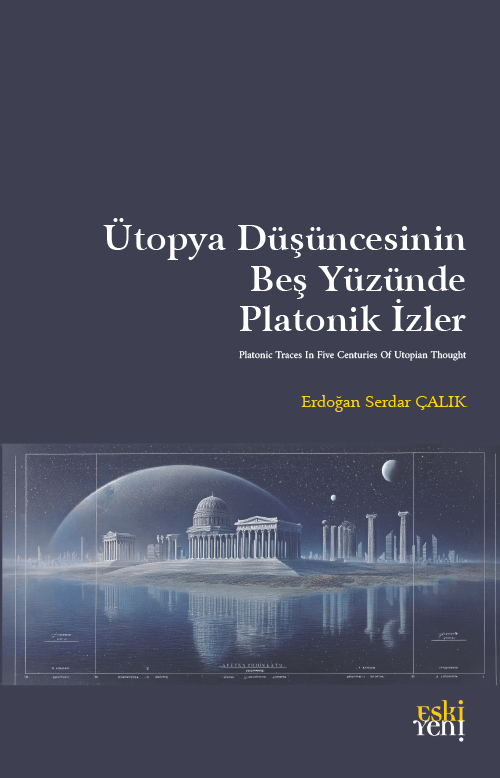
Platonic Traces In Five Centuries Of Utopian Thought
This study approaches the concept of utopia as a normative legacy centered
on Plato and examines the history of its transformation from Ancient
Greece to Islamic philosophy and the early modern period. Utopia
is understood here not merely as an imaginary societal design or a literary
genre, but as a foundational philosophical problem area that questions
the relationship between knowledge, virtue, and political authority.
The study’s fundamental claim is that the utopian tradition cannot
be understood without the normative framework established by Plato.
The ideal societal design, knowledge-based understanding of virtue,
and idea of cosmic order developed in Plato’s dialogues Republic, Laws,
and Timaeus formed a foundational reference point for all subsequent
utopian projects. This Platonic legacy was transferred to an Islamic legitimacy
ground in al-Farabi with the prophet-philosopher model. In
Ibn Bajja, the impossibility of political utopia was accepted and reduced
to an individual salvation strategy. This legacy, which in Thomas More
became a search for institutional balance within Christian humanism,
was reshaped in Campanella into a cosmic-theological state design, and
finally, in Francis Bacon, it underwent a conscious break as knowledge
was separated from moral guidance and evolved into an experimental
and technical form of power. Within this framework, the study interprets
utopian thought not as a field of historical diversity, but as a history
of continuity, transformation, and ruptures shaped around the relationship
between knowledge, virtue, and authority established by Plato.
Keywords: Utopia; Plato; Knowledge and Virtue; al-Farabi; Ibn Bajja;
Thomas More; Campanella; Francis Bacon

 İÇ SAYFALAR