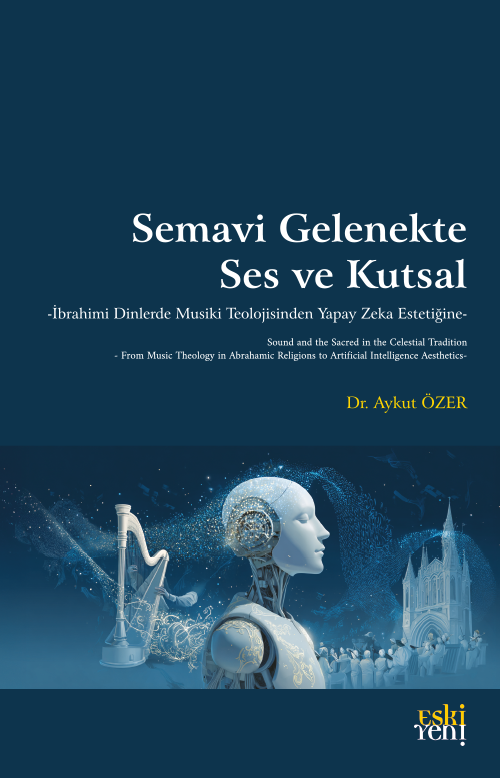
Sound and the Sacred in the Celestial Tradition
From Music Theology in Abrahamic Religions to
Artificial Intelligence Aesthetics
This work examines the phenomenon of sound, influence, and guidance
-one of the fundamental dynamics shaping human history- through a
broad perspective. It moves from theological origins in celestial traditions
to the digital aesthetics of the modern and postmodern eras,
specifically focusing on Artificial Intelligence (AI) technologies. The
study evaluates the rise of AI and the shift toward online living practices
(accelerated by the pandemic) not merely as technological progress,
but as an ongoing historical problem of power, control, and the production
of meaning. Centering on the recurring tension between truth
(hak) and falsehood (batıl) since the early periods of human history,
the book focuses on the sanctity and transformative power of sound. It
follows a line starting from the narrative of Adam and Iblis (Satan) to
the stories of Prophet David (Dawud) and Prophet Solomon (Suleiman).
Specifically, the concept of music and the “Davidic voice” attributed
to Prophet David in the Abrahamic tradition is interpreted not just as
an aesthetic element, but as a symbolic manifestation of divine will’s
influence over humans and nature. The narrative of Prophet Solomon is
handled within the context of regulating the relationship between the
visible and invisible realms, controlling fitna (discord), and reinforcing
the institution of the family.
While relating this theological and historical framework to the present
day, the work analyzes the post-2019 pandemic experience alongside
global psychological siege, economic vulnerability, and digital addiction.
The spatial confinement of the individual to the home, the placement
of digital tools at the center of daily life, and the dominance of
online platforms have profoundly impacted family structures, social
relations, and faith practices. The study also offers a critical discussion
on the relationship between this process and global governance mechanisms
and nation-state policies.
In the book, Artificial Intelligence is presented as an element that is
neither entirely dismissed nor absolute. Instead, AI is evaluated as a
powerful tool that -if control, ethics, and aesthetic boundaries are not
defined- could radically transform social structures, labor processes,
and intergenerational balances. The opportunities provided by AI in the
production of sound, image, and text are read on an analogical ground
with the forms of relationship established through the power of sound
in sacred texts. Thus, the continuity stretching from music theology to
digital aesthetics is made visible.
Keywords: History of Religions; Abrahamic Religions; Judaism; Christianity;
Islam; Religious Music; Artificial Intelligence; Interactive Education

 İÇ SAYFALAR