0 Items - ₺0,00
- Sepette hiç bir ürün yok.

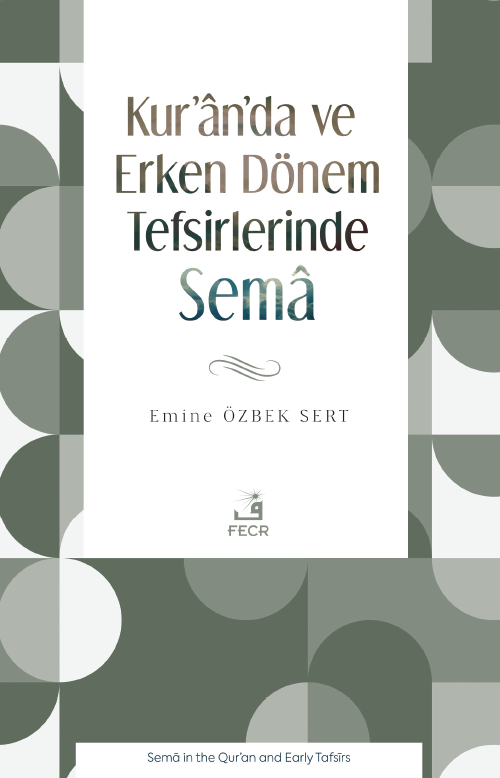
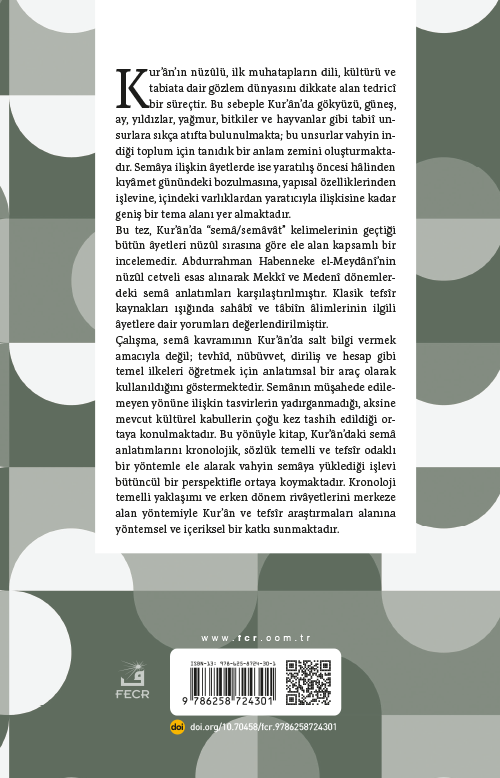
Orijinal fiyat: ₺600,00.₺420,00Şu andaki fiyat: ₺420,00.
 İÇ SAYFALAR
This study aims to explore Qur’anic verses containing the term
“semā/semā-wāt” through a primary focus on interpretations by the
Companions and the Tābiūn, while considering chronological themes
and early tafsīrs. The objective is to elucidate the Qur’anic depiction of
the heavens and illuminate the early commentators’ interpretations.
Structured into an introduction and two chapters, the study begins with
a clear statement of its subject, purpose, and methodological approach.
It also reviews existing research on the topic within the local context
and discusses perspectives of contemporary Turkish scholars regarding
the Qur’an’s linguistic and cultural significance.
In the first chapter, Qur’anic verses containing the word “semā/samawāt”
are analyzed within the context of their respective chapters, categorized
as Makkī and Madanī. The analysis concludes with the presentation and
evaluation of expressions and narratives featuring the word
“semā/samawāt” during the Makkan and Madinan periods, presented in
tabular format.
In the second part, the Qur’anic descriptions of “semā” were examined
through the lens of early tafsīrs, supplemented by lexical analysis of associated
terms. The verses concerning “semā” were thematically grouped
based on their intended message. The understanding and interpretations
of these verses by the Sahāba and Tābiūn were elucidated using
early tafsīrs. The analysis of these verses is structured around themes
such as “the initial state of the celestial sphere in the realm of existence,”
“its creation,” “its organization and completion,” “its structural characteristics,”
“its functional role in space,” “depictions of the celestial
sphere on the Day of Judgment,” and “the celestial sphere in divine narratives.”
The Qur’an frequently discusses the concept of the “sky,” often alluding
to its observable and unobservable aspects through terms such as
“semā/samawāt.” These references suggest a spiritual dimension beyond
the physical sky, articulated with formal descriptions. The Qur’an’s narrative
of the heavens differs notably from human-authored texts, indicating
a correction and refinement of existing perceptions among its initial
audience. Notably, the Qur’an introduces these concepts not merely as
viii
scientific revelations but as fundamental teachings concerning monotheism
(tawheed), resurrection, and divine judgment. Chronologically, the
Qur’an first mentions the heavens not in terms of their creation but in
the context of their ultimate dissolution on the Day of Resurrection. It
distinguishes between the construction and creation of the heavens,
emphasizing theological themes alongside its scientific content.
Keywords: Samā; Creation; Formal Structure; Revelation; Torment;
Blessing; Unseen Beings; Judgment And Heaven; First Interlocutors
| Genel Yayın No | 1817 |
|---|---|
| Marka | Fecr |
| Marka No | 1074 |
| ISBN | 9786258724301 |
| Yayım Tarihi | 20.01.2026 |
| Dil | |
| Boyut | 13,5 x 21 cm |
| Baskı Sayısı | 1 |
| Sayfa Sayısı | 460 |
| Kağıt Cinsi | 70 gr. Enzo |
| Kapak |