0 Items - ₺0,00
- Sepette hiç bir ürün yok.

Orijinal fiyat: ₺550,00.₺385,00Şu andaki fiyat: ₺385,00.
 İÇ SAYFALAR
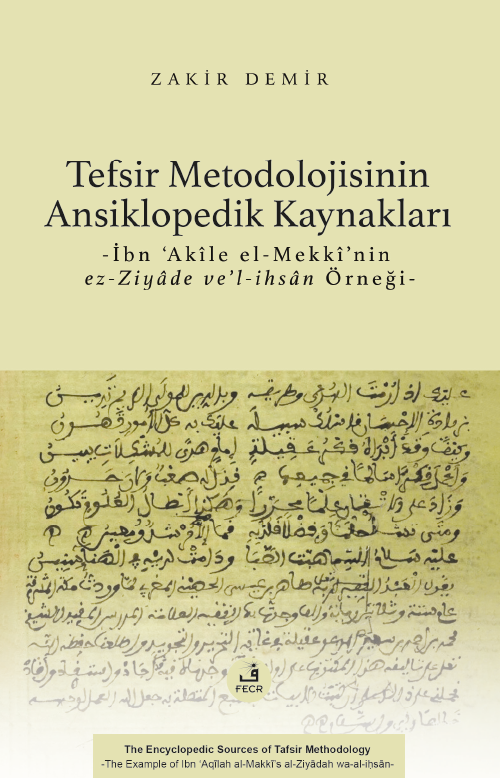
The Encyclopedic Sources of Tafsir Methodology
-The Example of Ibn ʻAqīlah al-Makkī’s al-Ziyādah wa-al-iḥsān-
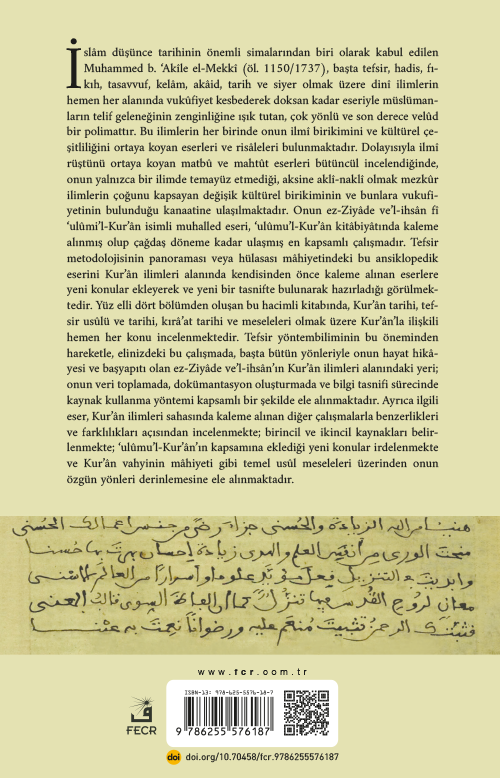
One of the foremost figures in Islamic intellectual history, Muḥammad
b. ʻAqīlah al-Makkī (d. 1150/1737) distinguished himself with mastery
in nearly every field of religious sciences—particularly in tafsīr,
ḥadīth, Islāmic history, Islāmic jurisprudence, mysticism, kalām,
akāid, and siyar. With nearly ninety works, he illuminated the richness
of the Muslim tradition of authorship, establishing himself as a wellrespected,
versatile and highly prolific polymath. In each of these
disciplines, he has authored works and treatises, showcasing his
intellectual accumulation and cultural breadth. Therefore, a holistic
examination of his published (al-maṭbūʻ) and manuscript (al-makhṭūṭ)
works, which attest to his intellectual maturity, reveals that his
expertise was not confined to a single field. Instead, he possessed a
broad and multifaceted scholarly foundation, encompassing most of
the aforementioned sciences and integrating both rational (al-ʻaqlī)
and transmitted (al-naqlī) traditions, demonstrating profound mastery
across diverse disciplines. His magnum opus, al-Ziyādah wa-al-iḥsān fī
ʻulūm al-Qurʼān, constitutes a foundational contribution to the
literature of Qur’ānic sciences, remaining the most exhaustive
scholarly work up to the modern era. It is observed that he composed
this encyclopedic work, which serves as both a panorama and a
synopsis of tafsīr methodology, by incorporating fresh and additional
topics, implementing a new classification within the field of Qur’ānic
sciences, distinguishing it apart from earlier works. In this voluminous
work, consisting of one hundred fifty-four chapters, nearly all topics
concerning the Qur’ān are examined, including its historical
development, the methodology of exegesis, exegetical approaches, the
principles of interpretation, the history of both the Qur’ān and its
exegesis, and the history of qırā’at. Building on the significance of this
in tafsīr methodology, the present study provides a comprehensive
examination of the life story of Ibn ʻAqīlah in all its aspects, the place
of his magnum opus, al-Ziyādah wa-al-Iḥsān, within the field of
Qur’ānic sciences, and his methodology of source usage in data
compilation, documentation, and information classification processes.
Furthermore, the relevant work is examined in terms of its similarities
and differences with other studies written in the field of Qur’ānic
sciences, its primary and secondary sources are identified, the new
topics it introduces to the scope of ‘ulūm al-Qur’ān are analyzed, and
its unique aspects are thoroughly explored through fundamental
methodological issues such as the nature of the Qur’ānic revelation.
Keywords: Exegesis; Qur’ān; Ibn ʻAqīlah al-Makkī; al-Ziyādah wa-aliḥsān;
ʻUlūm al-Qurʼān (Qur’ânic Sciences)
| Genel Yayın No | 1585 |
|---|---|
| Marka | Fecr |
| Marka No | 964 |
| ISBN | 9786255576187 |
| Yayım Tarihi | 01.03.2025 |
| Dil | |
| Boyut | 13,5 x 21 cm |
| Baskı Sayısı | 1 |
| Sayfa Sayısı | 402 |
| Kağıt Cinsi | 70 gr. Enzo |
| Kapak |