0 Items - ₺0,00
- Sepette hiç bir ürün yok.

Orijinal fiyat: ₺450,00.₺315,00Şu andaki fiyat: ₺315,00.
 İÇ SAYFALAR
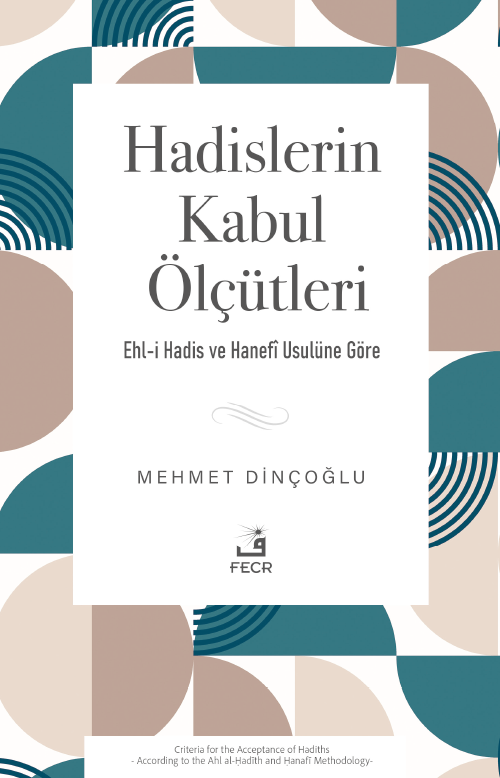
Criteria for the Acceptance of Hadiths
-According to the Ahl al-Ḥadīth and Ḥanafī Methodology-
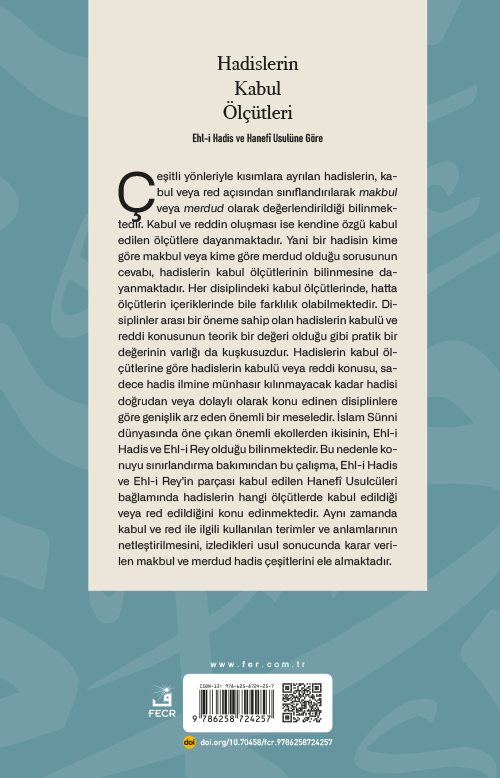
This book examines the issue of the acceptance and rejection of hadiths in Islamic intellectual
history within the framework of two major Sunni approaches: Ahl al-Ḥadīth
and Ḥanafī legal methodology. Although hadiths are universally recognized as the
second fundamental source of Islam after the Qur’an, they do not possess the same
level of certainty in terms of transmission. For this reason, different evaluative criteria
have been developed concerning both their attribution to the Prophet Muhammad
and their normative authority. These methodological differences have resulted in significant
divergences among Islamic legal and theological schools regarding the acceptance
and rejection of hadiths.
The primary aim of this study is to systematically identify and comparatively analyze
the criteria employed by Ahl al-Ḥadīth and Ḥanafī jurists in accepting or rejecting
hadiths. Rather than focusing solely on classical hadith criticism, the work centers on
the concept of “criteria for acceptance,” addressing the practical reality that some
narrations considered weak were accepted in practice, while others that met formal
conditions of authenticity were rejected. In this respect, the study seeks to clarify the
underlying methodological reasoning behind such evaluations.
The book consists of an introduction and two main chapters. The introduction outlines
the scope, significance, and objectives of the study, and clarifies key concepts
such as Ahl al-Ḥadīth, Ḥanafī jurists, hadith, sunnah, khabar, narration, isnād, and
matn. The first chapter examines the criteria for the acceptance of hadiths under
three main categories: narrator-related criteria (ʿadālah and ḍabt), isnād-related criteria
(continuity, interruption, and hidden defects), and text- and content-related criteria.
These criteria are analyzed in accordance with the methodological perspectives of
both schools. The second chapter focuses on the classification of hadiths based on acceptance
criteria, discussing the concepts of maqbul (accepted) and mardūd (rejected)
hadiths according to Ahl al-Ḥadīth and the Ḥanafī school, and examining the
legal and practical implications of this classification.
In conclusion, the book offers a comprehensive and objective analysis of the methodological
relationship between hadith methodology and legal theory, highlighting
inter-school differences and making a substantial contribution to the literature on the
criteria for the acceptance of hadiths.
Keywords: Criteria for the Acceptance of Hadiths; Ahl al-Ḥadīth; Ḥanafī Legal Methodology;
Hadith Criticism; Accepted and Rejected Hadiths
| Genel Yayın No | 1808 |
|---|---|
| Marka | Fecr |
| Marka No | 1070 |
| ISBN | 9786258724257 |
| Yayım Tarihi | 31.12.2025 |
| Dil | |
| Boyut | 16 x 24 cm |
| Baskı Sayısı | 1 |
| Sayfa Sayısı | 268 |
| Kağıt Cinsi | 70 gr. Enzo |
| Kapak |