0 Items - ₺0,00
- Sepette hiç bir ürün yok.

Orijinal fiyat: ₺250,00.₺175,00Şu andaki fiyat: ₺175,00.
 İÇ SAYFALAR
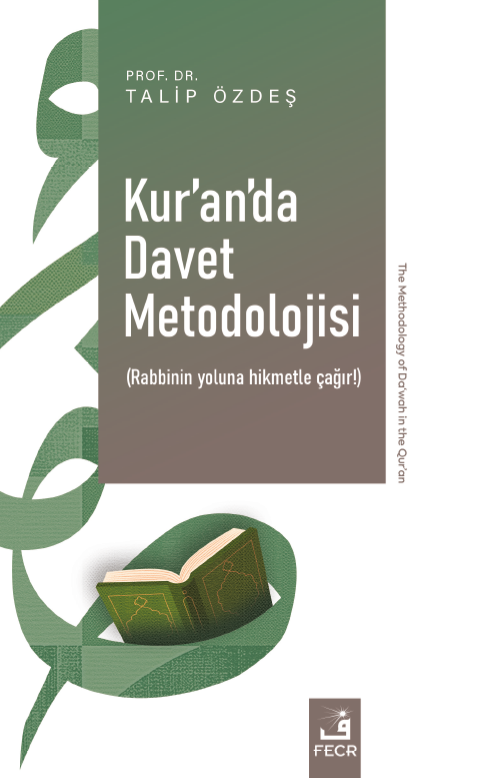
The Methodology of Da‘wah in the Qur’an
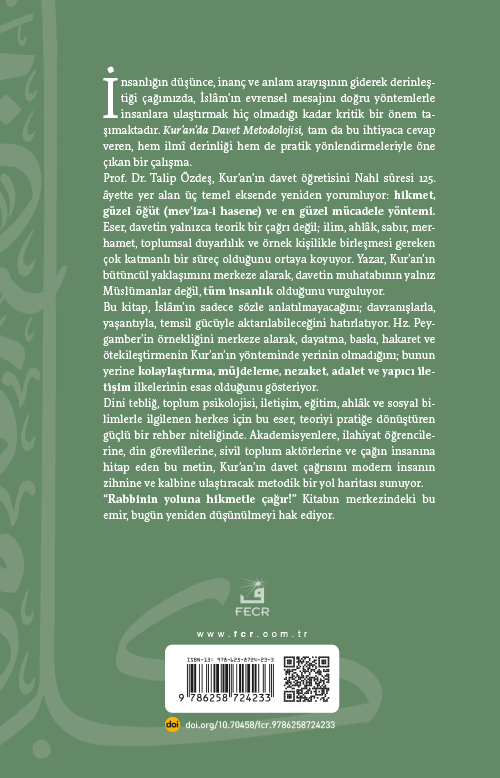
The Methodology of Da‘wah in the Qur’an is a comprehensive study that
examines the fundamental Qur’anic principles guiding the transmission of
Islam’s universal message to humanity. Anchored in the central verse of
Surah al-Nahl 16:125, the work analyzes in depth the three core components
of Qur’anic da‘wah: wisdom (ḥikmah), good admonition (maw‘iza
ḥasana), and the most gracious form of debate (jidal bi’llatī hiya aḥsan).
The author aims to reconstruct a holistic da‘wah framework by considering
theological, ethical, psychological, and social dimensions simultaneously.
The study first presents the conceptual foundations of da‘wah,
exploring its lexical meanings, Qur’anic usages, religious bases, and its
universal audience. It emphasizes that da‘wah is not an activity directed
only at Muslims but a comprehensive call addressed to all of humanity.
The author then elaborates on the essential qualities of a da‘i (caller to
Islam): credibility, knowledge, moral integrity, patience, humility, compassion,
and social sensitivity – drawing on both classical Islamic sources
and insights from modern psychology. One of the distinctive contributions
of the work is its emphasis on imitative/embodied da‘wah, which argues
that effective da‘wah must be demonstrated through lived ethical practice
rather than mere verbal instruction. By examining the exemplary conduct
of the Prophet Muhammad, the study underscores that moral embodiment
forms the most persuasive mode of communicating Islam. The book also
discusses the Qur’anic approach to debate and engagement, highlighting
that constructive dialogue should always be governed by politeness, respect,
fairness, and avoidance of coercion or disparagement. This establishes
the ethical core of Qur’anic da‘wah. Moreover, the author stresses
the necessity of utilizing contemporary social sciences – communication
studies, psychology, and sociology – to better understand human behavior
and to convey Qur’anic teachings more effectively in the modern world.
Overall, this work offers a comprehensive, methodologically rigorous
reinterpretation of the Qur’anic da‘wah paradigm, serving as a valuable
resource and guide for scholars, educators, community leaders, and all
individuals engaged in communicating Islam’s message today.
Keywords: Da‘wah; Wisdom (Ḥikmah); Good Admonition; Qur’anic Methodology;
Prophetic Model
| Genel Yayın No | 1803 |
|---|---|
| Marka | Fecr |
| Marka No | 1068 |
| ISBN | 9786258724233 |
| Yayım Tarihi | 31.12.2025 |
| Dil | |
| Boyut | 13,5 x 21 cm |
| Baskı Sayısı | 1 |
| Sayfa Sayısı | 162 |
| Kağıt Cinsi | 70 gr. Enzo |
| Kapak |