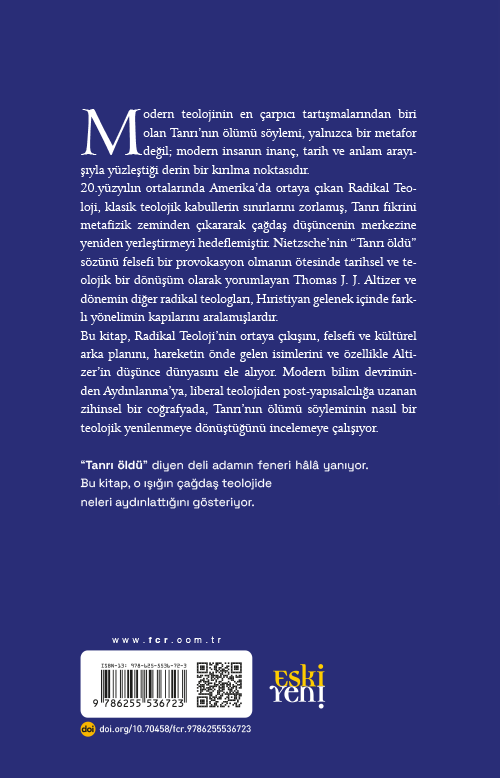
This study examines the Radical Theology movement-which constitutes
a significant turning point within contemporary theology-together with
its historical background, philosophical foundations, and theological
implications. Emerging particularly in the United States during the
1960s, Radical Theology interprets Nietzsche’s famous declaration that
“God is dead” not merely as a philosophical claim but as a theological
phenomenon that explains the transformation of modern culture. According
to this movement, the traditional conception of God has eroded
in the face of the modern scientific worldview, Enlightenment thought,
and processes of secularization; consequently, it has been argued that
Christianity can persist only through a new theological perspective that
fully acknowledges the death of God.
The first chapter of this study discusses the formative processes of modern
thought that prepared the ground for the emergence of Radical Theology,
including the rise of modern science, the Copernican revolution,
Newtonian mechanics, Enlightenment rationalism, liberal theology,
and materialist critiques of religion. This background is significant in
that it demonstrates how the relationship between God, nature, the human
being, and meaning was reconfigured during the modern era.
The second chapter comparatively analyzes the approaches of leading
figures of the movement such as Thomas J. J. Altizer, Gabriel Vahanian,
William Hamilton, and Paul van Buren. At the center of the study
stands Altizer’s dialectical theology, his understanding of incarnation,
and his interpretation of the death of God as a historical reality. According
to Altizer, the death of God represents an unavoidable threshold in
modern humanity’s search for meaning, and theology is compelled to
confront this historical reality.
Keywords: Death of God Theology; Radical Theology; Thomas Altizer;
Postmodernity; Secularization; Incarnation; Dialectical Theology

 İÇ SAYFALAR