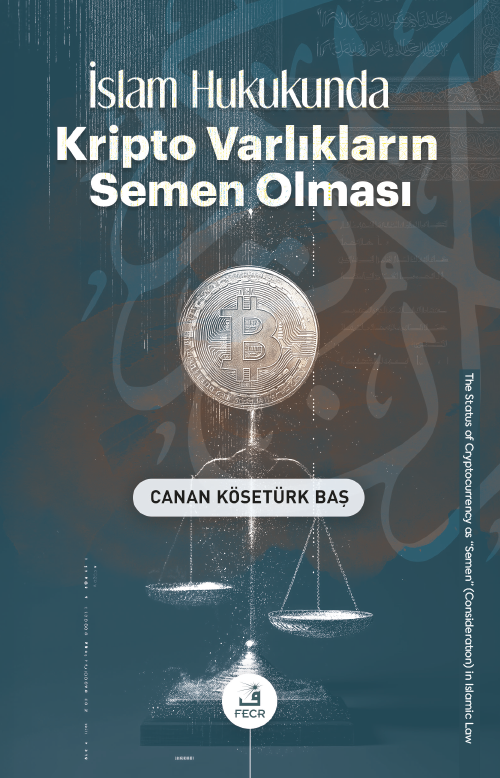
The Status of Cryptocurrency as “Semen”
(Consıderatıon) in Islamic Law
This study investigates the permissibility of using crypto assets as “semen”
(i.e., the counter-value or payment instrument) within the framework
of Islamic jurisprudence. The work focuses particularly on the
legal classification of Bitcoin and other digital assets in comparison to
classical definitions of money and property (mal) in traditional Islamic
legal texts. The non-physical, decentralized, and algorithmic nature of
cryptocurrencies complicates their classification within the established
categories of Islamic jurisprudence, such as tangible property (ʿayn) or
fungible commodities.
The analysis explores the three key functions of money-store of value,
medium of exchange, and unit of account-and evaluates whether crypto
assets fulfill these roles in a manner consistent with the Islamic concept
of semen. By drawing theoretical comparisons with gold and silver, the
study reconsiders classical views held by jurists such as Imām Mālik,
Abū Ḥanīfa, al-Shāfiʿī, and Aḥmad ibn Ḥanbal. The positions of contemporary
Islamic legal scholars are also examined.
The conclusion indicates that while there is no consensus in Islamic
law on treating crypto assets as semen, some scholars accept their use
under specific conditions. These include transparency, mutual consent,
rightful ownership, and the prevention of price manipulation or unjust
speculation. Therefore, the study suggests that crypto assets could potentially
function as lawful transaction mediums in Islamic law, provided
they comply with foundational Shariah principles.
Keywords: Crypto Assets; Islamic Law; Semen (Counter-Value); Bitcoin;
Digital Currency

 İÇ SAYFALAR