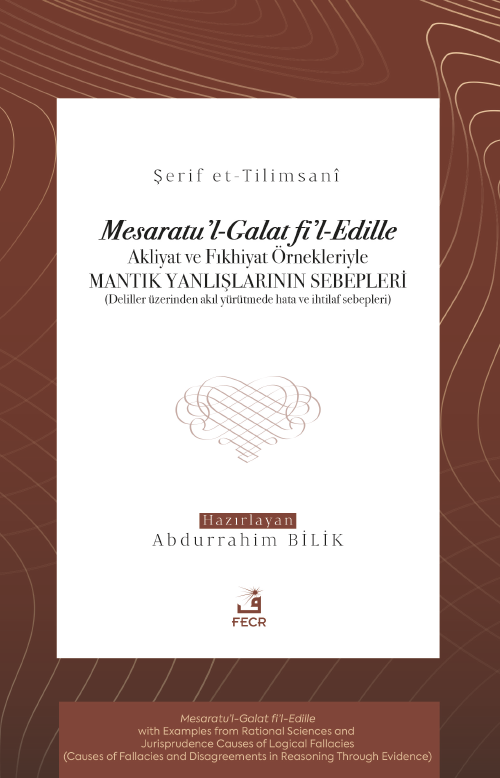
Mesaratu’l-Galat fi’l-Edille
Muhammad b. Ahmad al-Tilimsānī (d. 771/1370), who lived on the
Algeria-Tunisia line, was a Mālikī jurist and a versatile scholar who
played an important role in the development of logic and philosophy
in North Africa and Andalusia. Sharīf al-Tilimsānī established
close relations with the Sultan of the Merīnids, Abū Inān al-Fāris,
and became the teacher of his children in a period of political instability
but intense scholarly developments. He contributed greatly to
Tilimsān’s process of becoming a center of science and culture. One
of the most prominent works of Tilimsānī, who generally wrote
works on logic and methodology, is undoubtedly his book Mesaratu’l-
Galat fi’l-Edille.
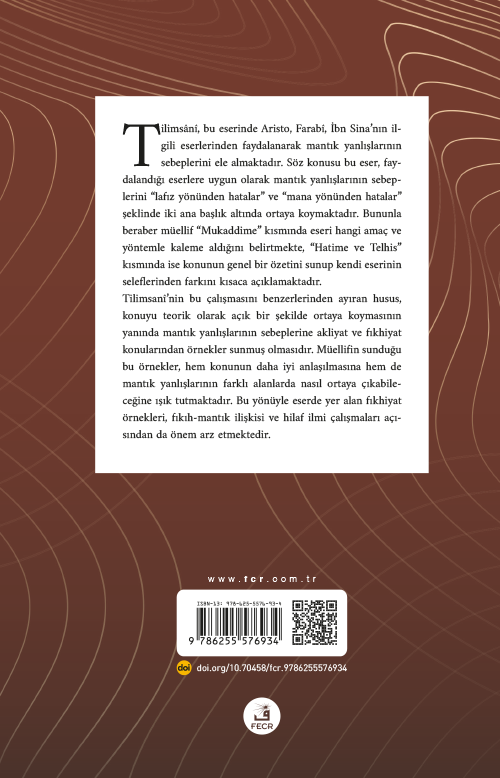
In this work, Tilimsani examines the causes of logical fallacies by
drawing on the relevant works of Aristotle, al-Fārābī, and Ibn Sina
(Avicenna). In accordance with the books he consults, this work presents
the causes of logical fallacies under two main headings: “Logical
fallacies originating from wording” and “Logical fallacies originating
from meaning”. Furthermore, in the “Introduction,” the author
states the purpose and methodology behind the work. In the
“Examination and Summary,” he provides a general summary of the
topic and briefly explains how his work differs from its predecessors.
What distinguishes this work by Tilimsānī from its peers is that, in
addition to its clear theoretical explanation of the subject, it also
provides examples from both “rational sciences” and “jurisprudence”
to illustrate the causes of logical fallacies. These examples
provide a better understanding of the subject and illuminate how
logical fallacies can arise in various fields. In this respect, the examples
from jurisprudence included in the work are also important for
the relationship between jurisprudence and logic and for studies on
the Ilm al-khilaf.
Keywords: Logic; Fıqh; Fallacy; Khilaf; Tilimsānī

 İÇ SAYFALAR