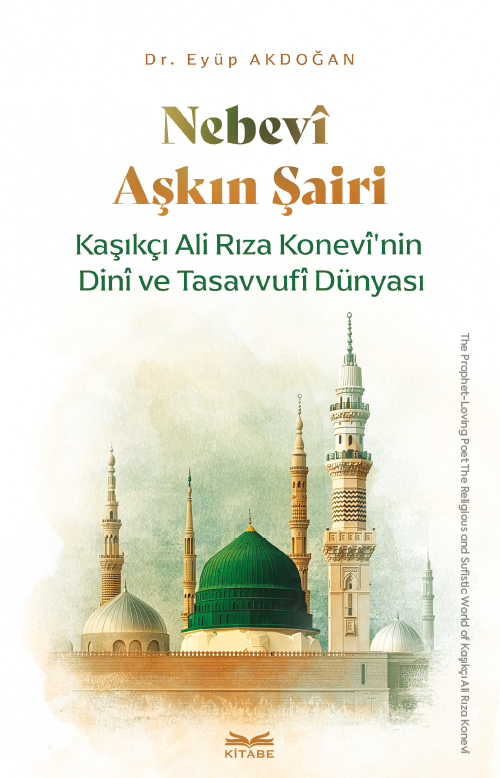
The Prophet-Loving Poet
The Religious and Sufistic World of Kaşıkçı Ali Rıza Konevî
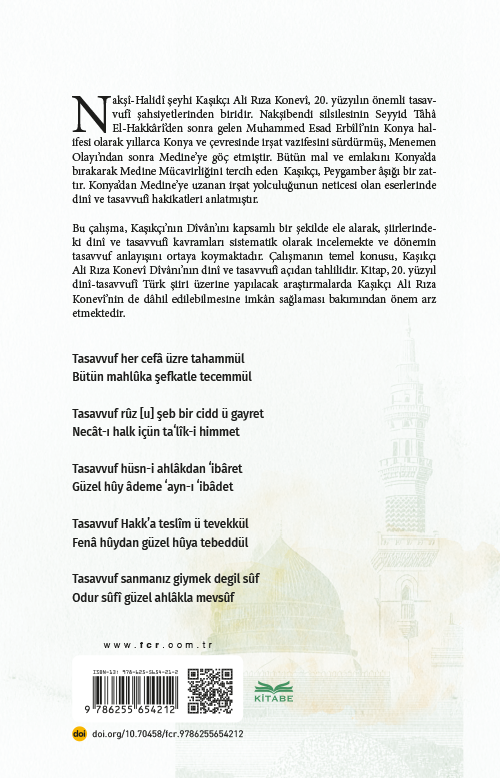
Kaşıkçı Ali Rıza Konevî (b. 1949) stands as a distinctive figure within the
Naqshbandī-Khālidī tradition, notable for both his scholarly formation and
his profound spiritual orientation. Initially trained in the exoteric Islamic sciences,
he turned to Sufism upon realizing that these disciplines did not provide
the spiritual fulfillment he sought. His search culminated in his affiliation
with Muhammad Esad Erbīlī, one of the era’s foremost Sufi masters,
from whom he later received caliphal authorization. Kaşıkçı continued his
guidance activities in Konya until the Menemen Incident, after which he was
compelled to leave the city and ultimately settled in Medina. There he sustained
his intellectual and spiritual endeavors through extensive correspondence
and authored works, maintaining his role as a spiritual guide until the
end of his life.
Among his writings, the Dîvân occupies a central position as a work in which
poetic expression, religious reflection, and mystical experience converge.
The text demonstrates Kaşıkçı’s deep engagement with the classical Islamic
tradition, evidenced by Qur’anic citations, allusions to prophetic hadiths, and
an elaborate mystical vocabulary. This study undertakes a systematic examination
of the religious and Sufi content in the Dîvân. All relevant concepts
were identified, categorized, and analyzed with attention to their lexical, technical,
and Sufi meanings, followed by an assessment of the specific interpretive
framework Kaşıkçı constructs around them.
The first section analyzes Kaşıkçı’s treatment of fundamental religious concepts,
including theological, ritual, and scriptural themes. The second section
explores his understanding of key Sufi notions, such as waḥdat al-wujūd
(unity of existence), the stages of sulūk (spiritual journey), and the ideal of
the insān al-kāmil (perfect human). The concluding section synthesizes these
findings, delineating the overarching structure of Kaşıkçı’s religious-mystical
worldview and situating his thought within the broader context of modern
Sufi literature. In doing so, the study contributes to a deeper understanding of
both his spiritual legacy and the intellectual-mystical climate of his period.
Keywords: Turkish Islamic Literature; Kaşıkçı Ali Rıza Konevi; Divan; Religion;
Sufism

 İÇ SAYFALAR