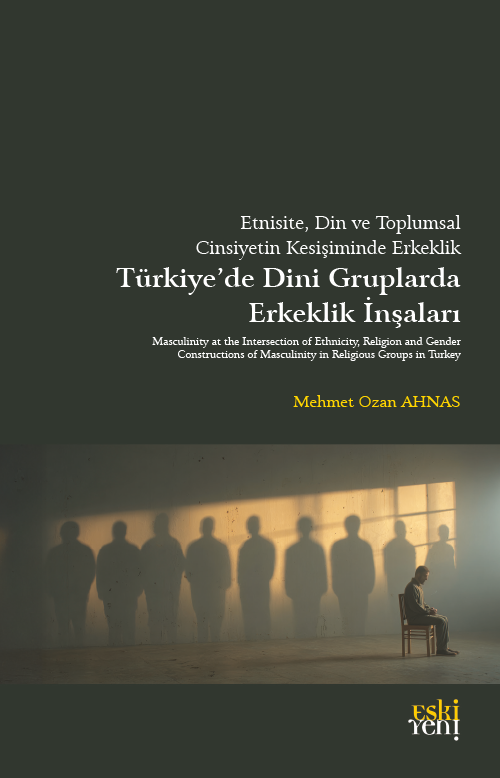
Masculinity at the Intersection of Ethnicity, Religion and Gender
Constructions of Masculinity in Religious Groups in Turkey
Academic focus on masculinity has been increasing in recent years.
Masculinity studies, which address an interdisciplinary field of research,
draws from numerous fields such as sociology, psychology, and
women’s studies. Studies focusing on women’s practices within the patriarchal
power hierarchy have neglected male identity and the process
of its construction. Therefore, while explaining women’s roles as
mothers, girlfriends, wives, and workplace colleagues in shaping masculinity,
it is also important to examine men’s practices. In Turkey, religion-
gender or ethnicity-religion studies represent a well-developed
field of research. However, it can be argued that theoretical or empirical
studies that examine religion-ethnicity-masculinity within the same
axis remain limited. Taking this gap in the literature into account, our
book explores how masculinity is shaped within religious groups in the
Turkish context and how this intertwines with ethnicity, utilizing intersectional
analysis. The interaction of masculinity with religious practices
and discourses, combined with the cultural codes of ethnic identities,
creates a unique field of research within the social sciences. This is one
of the important reasons that drives the curiosity of the issues discussed
in our book. Masculinity is not merely a practice of belief, but also a
performative identity composed of relations of authority and belonging.
Therefore, power structures within religious and ethnic groups play a
functional role in the production of gender identities. In Turkey, religious
groups, particularly religious orders, determine men’s positions of
authority and produce symbolic and cultic forms of masculinity. Ethnicity,
in turn, determines categories of both belonging and exclusion
in this process.
Keywords: Masculinity-ethnicity and religion; Definitional masculinity;
Religious community masculinity; Muslim masculinity; Performative
masculinity; Multiple masculinities

 İÇ SAYFALAR