The Nature of Things
A Philosophical Inquiry in the Context of Tahāfut al-Falāsifa
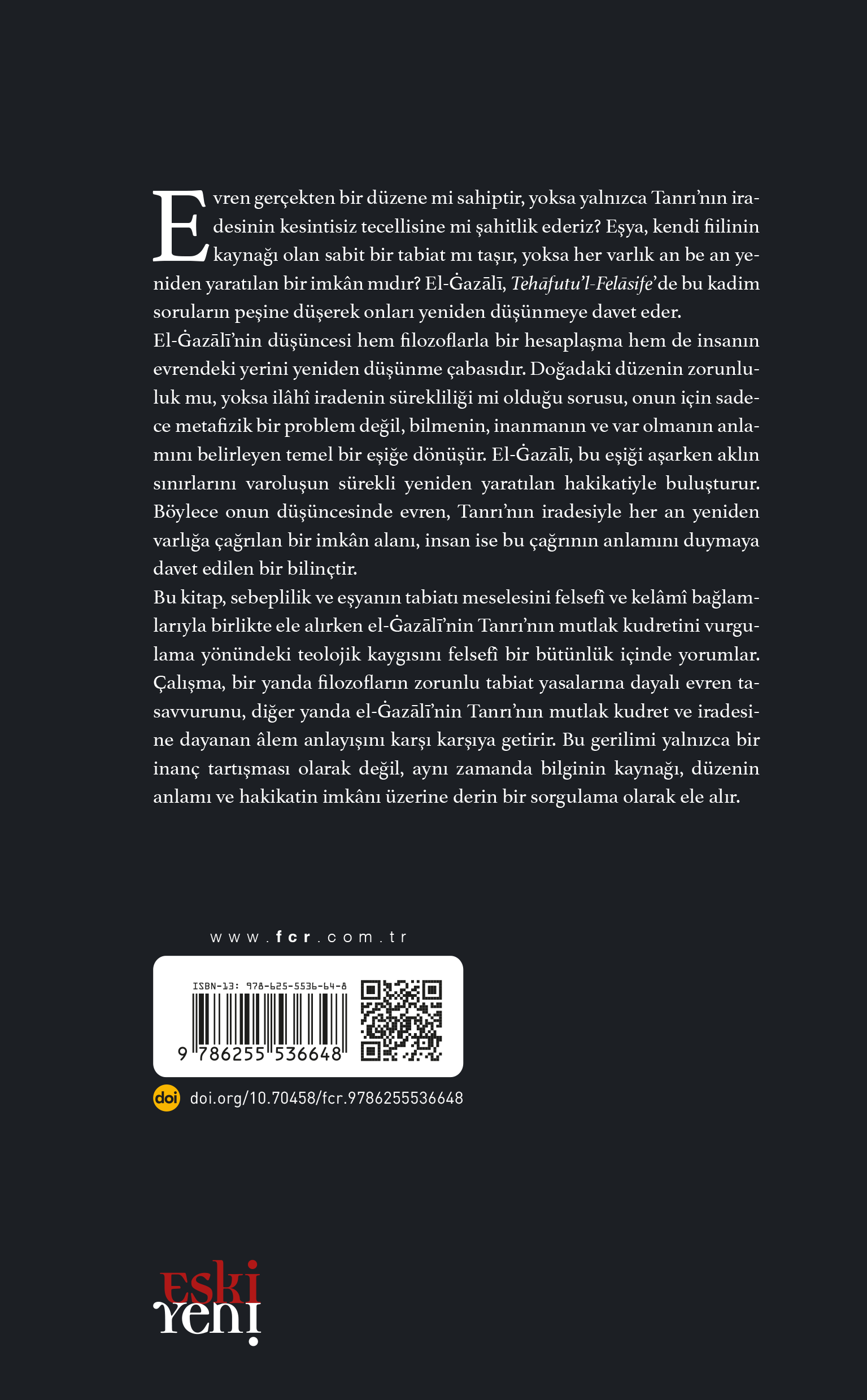
This book aims to examine the discussions on causality and the nature
of things in al-Ghazālī’s Tahāfut al-Falāsifa, with a particular focus on
the seventeenth problem, situating them within their philosophical and
theological contexts. The study analyzes the arguments and intellectual
concerns through which al-Ghazālī rejects the philosophers’ doctrine of
necessary causation, as well as the interaction between this rejection
and his theological commitment to preserving God’s absolute power and
will. According to al-Ghazālī, the observable sequences in nature do not
arise from the intrinsic powers of things but from God’s continuous act
of creation. Hence, natural laws are not ontological necessities, as the
philosophers maintain, but rather stable habits of divine will. This perspective
transforms not only the conception of the natural order but
also the very foundations of knowledge. For if things possess no fixed
and active natures of their own, then human knowledge rests not on
nature itself but on the constancy of divine will. In this sense, knowledge
becomes a relation of trust grounded not in necessity but in divine
regularity and reliability. The first part of the book provides a historical
background by examining the discussions on causality and the nature of
things within the pre-Ghazālian theological and philosophical traditions,
especially among the Muʿtazilites, the Ashʿarites, and al-Juwaynī. The
second part focuses on al-Ghazālī’s critique of necessary causation in
the seventeenth problem of the Tahāfut, offering a comparative analysis
with Ibn Sīnā’s systematic metaphysics and Ibn Rushd’s counterarguments
in Tahāfut al-Tahāfut. Additionally, the study explores the extent
to which al-Ghazālī approaches the issue through his understanding of
burhān. Ultimately, this work reveals the points of interaction between
ontology, epistemology, and theology within al-Ghazālī’s intellectual
system. His critique of necessary causation and his conception of the
world as a realm of ongoing divine creation invite a deeper reflection on
the interrelations among nature, knowledge, God, and the human being.
Keywords: Al-Ghazālī; Tahāfut al-Falāsifa; Nature; Thing(s); Causality

 İÇ SAYFALAR