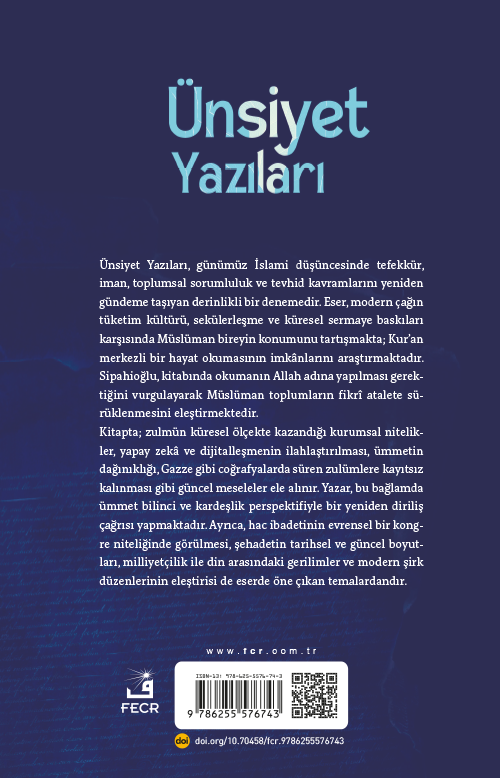
Ünsiyet Writings by Celaleddin Sipahioğlu is a profound work that revisits
the concepts of reflection, faith, social responsibility, and tawhid
in contemporary Islamic thought. The book addresses the challenges
faced by Muslims in the context of consumer culture, secularization,
and the pressure of global capitalism, while exploring the possibilities
of a Qur’an-centered reading of life. Emphasizing that true reading
must be undertaken in the name of God, Sipahioğlu criticizes the intellectual
stagnation of Muslim societies.
The work highlights several pressing issues: the institutionalized forms
of global oppression, the idolization of artificial intelligence and digital
technologies, the disunity of the Muslim ummah, and the widespread
indifference to ongoing atrocities in regions such as Gaza. From
this perspective, the author calls for a revival rooted in brotherhood
and collective consciousness. Furthermore, the book underscores
themes such as the pilgrimage (ḥajj) as a universal congress, the spiritual
and historical significance of martyrdom, the tensions between
nationalism and religion, and a critique of modern systems of polytheism.
By recalling the Ottoman experience of religious solidarity, Sipahioğlu
proposes it as a model for contemporary Muslims, while also urging
resistance against capitalism’s reduction of human beings to “consuming
animals.” The text advocates for an integrated Islamic vision that
prioritizes not only individual piety but also social cohesion and solidarity.
In conclusion, Ünsiyet Writings provides significant theological, ethical,
and socio-political insights for reconstructing Muslim identity in
the modern era. It stands as an original resource that evaluates contemporary
crises through a Qur’anic perspective, making it valuable
both for academic scholars and for reflective Muslim readers seeking
guidance in a turbulent world.
Keywords: Ünsiyet Writings; Tawhid; Modern Idolatry; Islamic Reflection;
Ummah Consciousness


 İÇ SAYFALAR