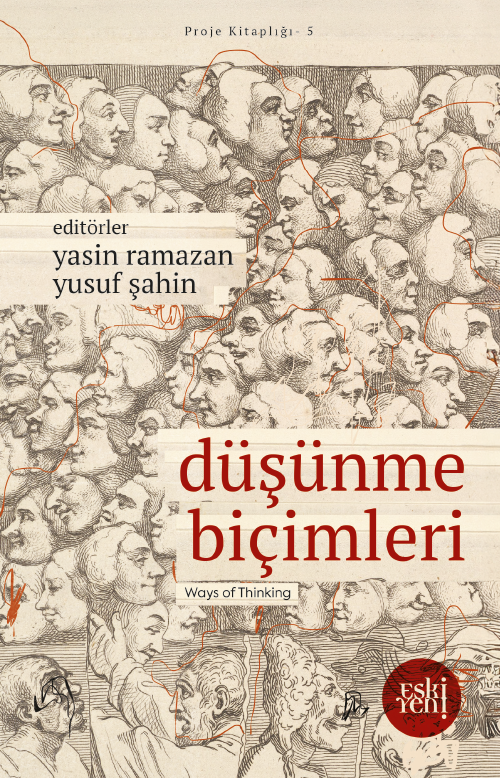
Ways of Thinking
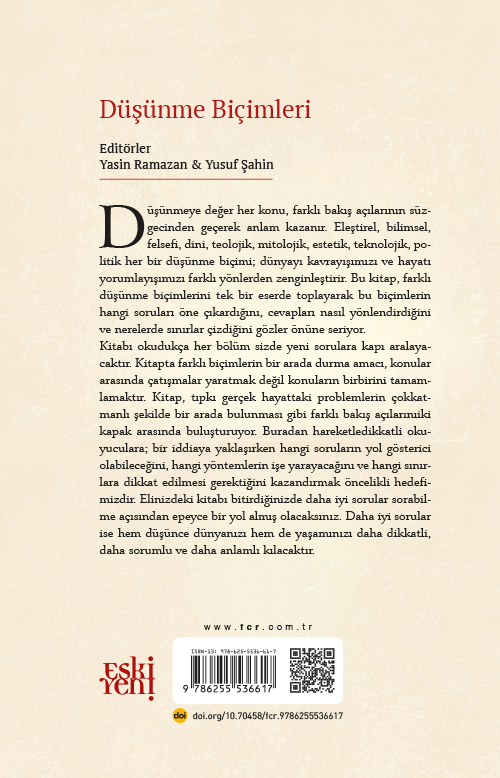
Thinking points to a field that is far too broad to be reduced to creating a list
that distinguishes right from wrong. Thinking takes place in a cognitive space
where the relationship we establish with life, the questions we ask, and the
answers we give manifest themselves in different forms. This book, entitled
Ways of Thinking, sheds light on the multifaceted workings of the human mind
by bringing together different styles of thinking. The book examines various
fundamental approaches to ways of thinking, such as critical, philosophical,
scientific, theological, religious, mythological, technological, virtual and political
thinking. Each chapter confronts the reader with original questions from
different perspectives: critical thinking questions the reliability of evidence,
while philosophical thinking discusses the meaning of knowledge and the
question itself. Scientific thinking emphasises experimentation and falsifiability
criteria, while theological and religious thinking focuses on the relationship
between reason and the dimensions of faith, ritual, and social identity. Mythological
thinking reveals the world of symbols and collective narratives, while
technological thinking opens up a discussion on the ethical and political consequences
of the tools that transform modern life. Artistic thinking conveys the
world’s precariousness, while political thinking draws attention to the effort
arising from the necessity of people living together.
These texts aim to cultivate in the reader a habit of evaluating different
perspectives together, rather than absolutising a single way of thinking.
For real-life problems are often multi-layered; a claim or issue requires
consideration in its moral, epistemological, and social dimensions. The
book encourages recognising this plurality and asking the right questions
where necessary. Ways of Thinking is a roadmap that goes beyond being
an academic work and invites the reader to a more attentive, responsible,
and meaningful practice of thinking. Through the questions posed at the
end of each chapter, the reader will achieve a clearer understanding and a
broader intellectual horizon.
Keywords: Critical Thinking; Philosophical Thinking; Scientific Thinking;
Theological Thinking; Religious Thinking; Mythological Thinking; Technological
Thinking; Artistic Thinking; Political Thinking.

 İÇ SAYFALAR