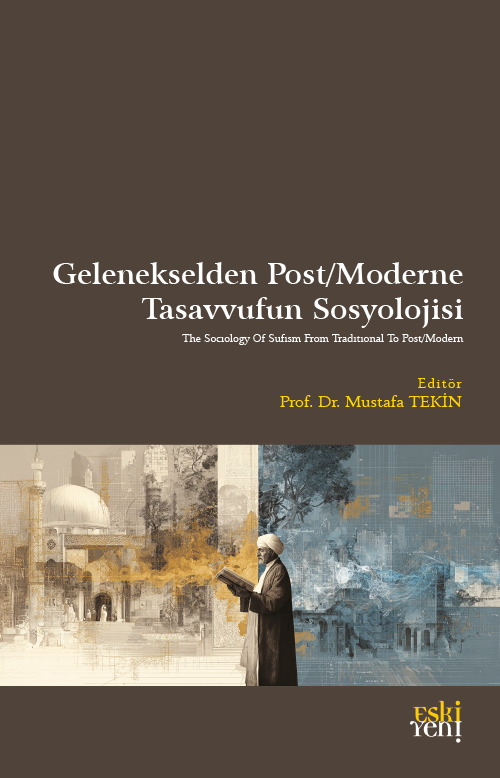
The Sociology of Sufism From Traditional Tto Post/Modern
The ontological and epistemological rupture that accompanied modernity
brought about a systematic new perspective on the world. In this vein,
modernity, which has gained global prevalence worldwide, has been accompanied
by developments in many fields. It is necessary to highlight
the logistical support of the social sciences, and sociology in particular, in
both the construction and the establishment of modernity. This situation
demonstrates that while Western epistemology is being developed paradigmatically
through the social sciences, this epistemology plays a transformative
role in the world’s diverse cultures and civilizations. Thus, religions
and cultures other than the West can only exist through adaptation
to the West. Consequently, they constantly strive to read and understand
themselves through Western epistemology.
This problem has begun to be discussed in Muslim societies in the contemporary
era. Indeed, starting with the “Islamization of knowledge,” the
relationships between Islam, the social sciences, and sociology have been
examined as problems. However, in reality, complete continuity has not
been achieved. Building on this intellectual background, the relationships
between Islamic sciences and sociology have been addressed in a series of
studies. One of the links in this series is the sociology of Sufism.
This study, titled “The Sociology of Sufism from Traditional to Post/Modern,”
attempts to provide sociological analyses of various themes within
Sufism. It examines the forms and socialities that emerged in Sufism’s
relationship with society, both in the traditional era and in our current
era. This study, edited by Mustafa Tekin, consists of three sections. A total
of thirteen authors contributed. The first section contains articles addressing
the emergence of Sufism as an ascetic movement, its position within
social classes, and Christian mysticism. The second section examines the
evolution of the Sufi tradition, the understanding and changes of Sufism
within the tradition and in the contemporary era, and analyses of Sufism
in Turkey. The third section discusses Sufism’s interactions with postmodernism
and posthumanism, as well as portraits of contemporary Sufis. The
study addresses questions posed about Sufism in the contemporary world
and carries current implications for the study.
Keywords: Sufism; Sociology; Wisdom; Tarikat; Society

 İÇ SAYFALAR