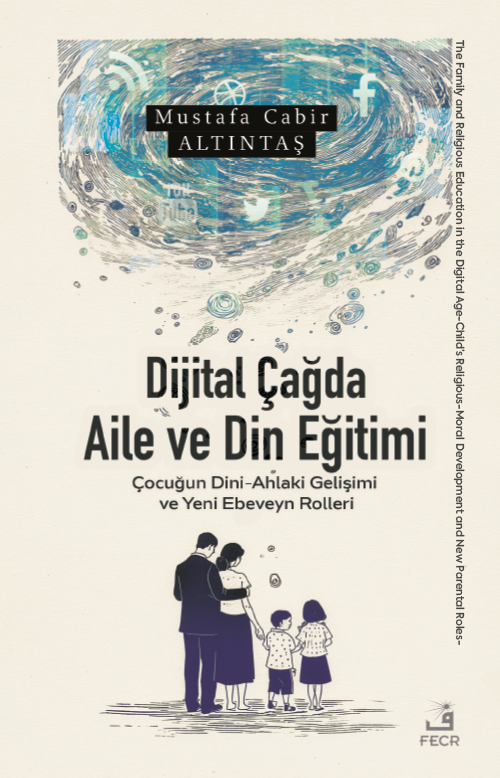
The Family and Religious Education in the Digital Age
Child’s Religious-Moral Development and New Parental Roles
This work analyzes the profound transformation experienced by the
family institution in the digital age on a sociological, theological, and
pedagogical interdisciplinary basis. The core thesis is that despite macrosocial
processes such as globalization, individualization, and digitalization
narrowing the family’s traditional structural and functional
roles (production, education, protection), the family retains its primary
and irreplaceable role in shaping the individual’s psychosocial and religiousmoral
identity. The study aims to present a holistic pedagogical
framework to safeguard the child’s innate (fıtrî) development of faith
and morality against the challenges posed by the digital age to the family
institution.
The work stands as one of the most comprehensive analyses in the field,
employing a document analysis that delves into traditional and contemporary
sociological theories. The study scrutinizes the transformation of
the family and the distinctive cultural dynamics of the Turkish family
structure, aiming to be a significant contribution to Turkish family literature.
The main focus of the book is the view that religious education and
moral education are two fundamental and inseparable disciplines and
that the permanence of this education hinges upon adherence to the
basic principles of Islamic Pedagogy. Within the context of Religious
Education Principles and Methods, it is demonstrated that the Prophetic
Method (Nebevi Yöntem) applied by the Prophet Muhammad (PBUH)
perfectly encompasses principles emphasized by modern education,
such as love, compassion, and developmental steps. This method advocates
for new parental attitudes, prioritizing the strengthening of the
child’s will and conscience to foster self-control, rather than adopting
detrimental approaches like oppressive, indifferent, or inconsistent parenting.
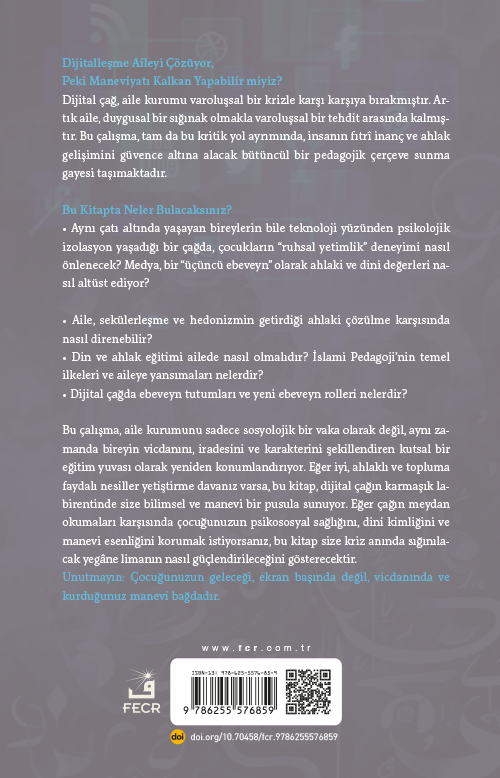
A key emphasis is placed on the Digitalization process, where mass
communication tools function as a “third parent” and threaten moral
values. These challenges necessitate transforming the family-centered
approach and the parental responsibility of being a role model (Üsve-i
Hasene) into active spiritual guidance. The fundamental idea is reinforced
that the family institution is not merely a biological union but
a sacred trust that ensures the continuity of the social structure and
aims to guide the individual toward both religious and moral maturity.
The work integrates the universal values of Islam and the methods of
Islamic Pedagogy with findings from modern psychology and sociology
to present a holistic and applicable solution framework to the crisis in
question.
Keywords: Religious Education; Family; Digital Age; Moral Development;
Parental Attitudes; Child

 İÇ SAYFALAR