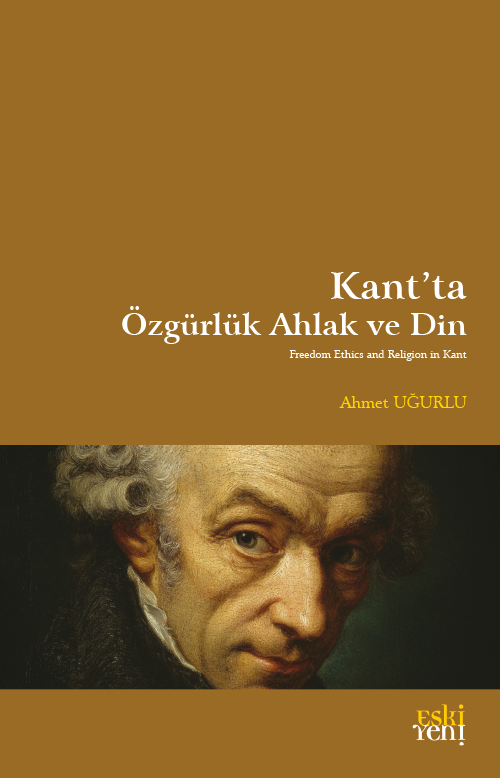
Freedom Ethics and Religion in Kant
This work examines the relationship between freedom, ethics, and religion
within Kant’s philosophical system. The author, Ahmet Uğurlu,
emphasizes that approaching Kant’s critical philosophy solely through
the lens of the first Critique prevents a full understanding of his thought
as a whole. Therefore, the book focuses particularly on the connection
between practical reason, Kant’s moral philosophy, and his philosophy
of religion. For Kant, freedom is the necessary condition of the moral
law and can be experienced within every individual’s inner life. In this
context, freedom opens a sphere not subject to the causality of natural
laws and positions the human being as an autonomous agent.
The book discusses in detail the link Kant establishes between the moral
law and the concept of the highest good. According to Kant, neither God
nor the immortality of the soul can be proven theoretically; however,
they must be accepted as postulates of practical reason. Thus, the completion
of morality—that is, the realization of the highest good—
necessitates religion. This approach finds its expression in the notion of
the “religion of pure reason.” Unlike historical and institutional religions,
the religion of pure reason is rational, universal, and stripped of
anthropomorphic elements.
The book also explores the differences between classical revealed religions
and Kant’s religion of pure reason. While classical religions reduce
goodness to obedience to God’s commands, Kant’s morality-centered
conception of religion rests on the struggle of the free individual to align
intentions with the moral law. This struggle is regarded not only as an
individual duty but also as a social responsibility. Uğurlu systematically
analyzes the distinctive aspects of Kant’s understanding of religion that
diverge from both classical theology and traditional religions, highlighting
his contribution to modern philosophy of religion.
Keywords: Kant; Freedom; Moral Law; Religion of Pure Reason; Highest
Good

 İÇ SAYFALAR