Ḥanafī Jurist Abū al-Qāsim al-Saffār and His
Jurisprudential Opinions on Matters of Worship
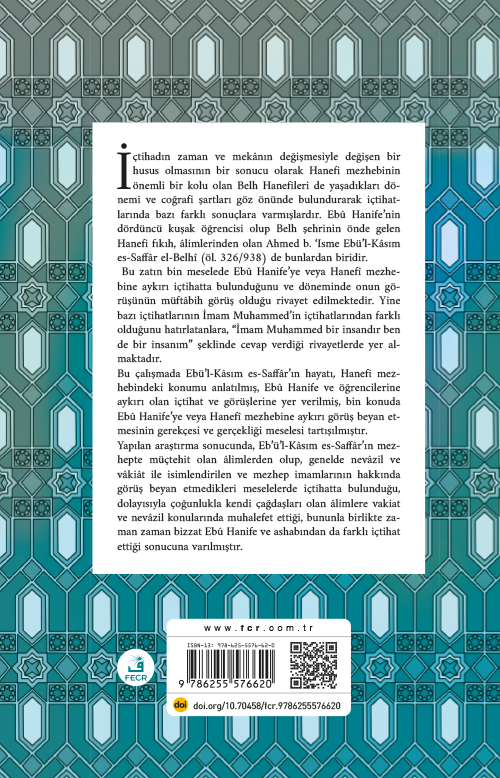
As a consequence of the principle that legal reasoning (ijtihād)
may change due to variations in time and place, the Belk branch
of the Ḥanafī school -one of its significant subdivisions- also
reached different legal conclusions by considering the
circumstances of their era and geographical context. A
prominent representative of this tradition is Aḥmad b. ʿIsma,
Abū al-Qāsim al-Ṣaffār al-Balkhī (d. 326/938), who was not only
a jurist, but also a traditionist (muḥaddith), linguist, and poet. Al-
Ṣaffār was a fourth-generation student of Abū Ḥanīfa and one of
the leading Ḥanafī scholars of the city of Balkh. It has been
reported that he himself claimed to have issued legal opinions
that contradicted those of Abū Ḥanīfa or the Ḥanafī school in a
thousand matters, and that in his time, his own views were
considered the authoritative opinions to be followed (muftā bih).
When reminded that Imām Muḥammad had held a differing
view on a particular issue, he is known to have replied, “huwa
rajulun wa anā rajulun” (“He is a man, and I am a man as well”).
This study explores the life of Abū al-Qāsim al-Ṣaffār, his place
within the Ḥanafī School and his legal views that diverged from
those of Abū Ḥanīfa and his students. The study also discusses
the rationale and veracity of his claim to have diverged from
Abū Ḥanīfa in a thousand issues.
The research concludes that Abū al-Qāsim al-Ṣaffār was a
mujtahid within the Ḥanafī school, particularly active in the area
of nawāzil (novel legal issues) and wāqiʿāt (practical cases), for
which the earlier imams of the school had not provided explicit
rulings. Moreover, in many instances where he is said to have
contradicted Abū Ḥanīfa or his two principal students (Abū
Yūsuf and Muḥammad al-Shaybānī), his opinions are actually
based on preferring the view of one over the other. Thus, the
claim that he contradicted Abū Ḥanīfa in a thousand issues
cannot be upheld in its entirety. However, it is accurate to state
that he often differed from his Ḥanafī contemporaries on matters
of nawāzil and wāqiʿāt. It is also a fact that he occasionally
expressed legal opinions that departed from those of Abū Ḥanīfa
and his disciples. Such divergences may be understood as
examples of istiḥsān-the application of juristic preference for the
sake of particular benefits or necessities, even if this entails
departing from the established views of the school.
Keywords: Islamic Law; Different Jurisprudence Within the
Sect; Hanafi Sect; Balkh Scholars; Abū al-Qāsim al-Ṣaffār


 İÇ SAYFALAR