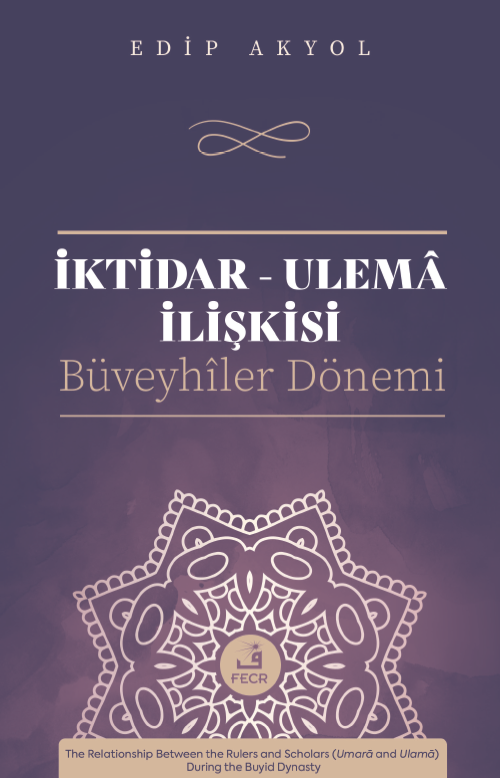
The Relationship Between the Rulers and Scholars
(Umarā and Ulamā) During the Buyid Dynasty (334-453/945-1062)
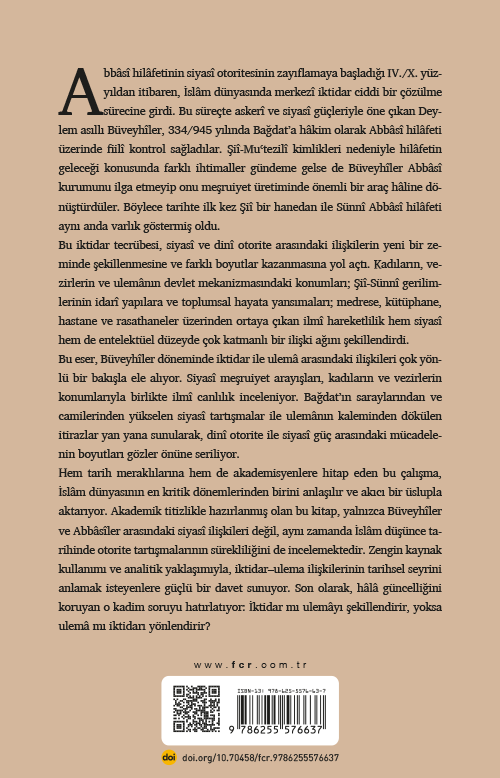
The book examines the relationship between rulers and scholars
(umarā and ulamā) during the Buyid period (334-453/945-1062), a
Daylamite dynasty reigned in Iran and Iraq with Shi‘ī inclinations and
Mu‘tazilī influences.
The Buyids emerged as a new force after capturing the center of
caliphate, Baghdad, by taking advantage of contemporary political
turmoil. Although debates arose regarding the establishment of a Shi‘ī
caliphate, the Buyids preferred to remain within the Abbasid system
rather than establishing their own governance. As a result of this
decision, Shi‘ī Buyids and Sunni Abbasid Caliphate shared ruling
power simultaneously for the first time in history. This socio-political
context created inspirational environment for the intellectual
enhancement of scholars, their scholastic contributions, and the rulers’
interest in knowledge and the scholars.
The book elucidates the sectarian policies of the Buyids, their impact
on religious and social life, and the attitudes of the ulamā towards
these practices. On the one hand, it highlights the Buyid’s activities
that triggered Shiite-Sunni conflicts in terms of religious
understanding. On the other hand, it explains the Buyid’s significant
contributions to Islamic science, culture, and civilization. Additionally,
the book also analyses the roles of the scholars in political,
administrative, and judicial spheres, their interventions of political
power in these areas, and the reaction of rulers toward the ulamā.
Lastly, the book critically compares the approaches of the Buyid rulers
and Abbasid caliphs towards dissident ulama of the contemporary
period.
Keywords: Ruler (Umarā), Scholars (Ulamā), Buwayhids, Buwayhid
Rulers, Abbasids, Rulers-Scholars Relationship.

 İÇ SAYFALAR