Quiddity and Existence in Avicenna and His Commentators
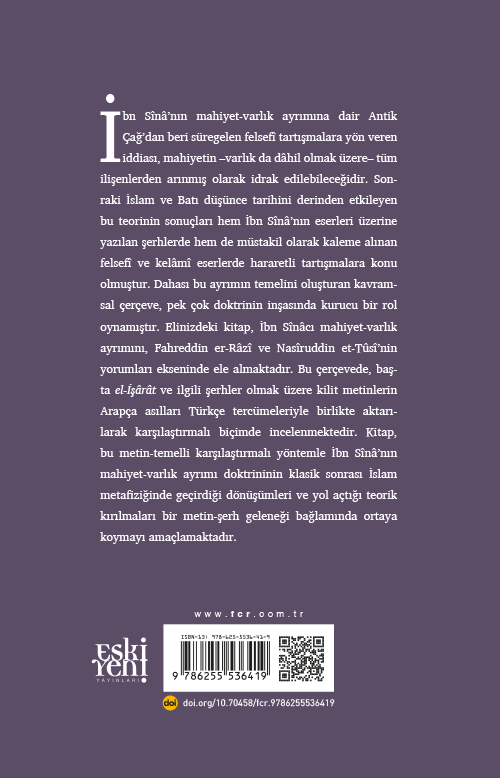
In order to elucidate the ontological otherness between the Necessary
Existent and contingent existents, Avicenna made a real distinction, to
a certain extent, between quiddity and existence; he maintained that in
contingent existents, existence is an accidental concomitant to quiddity,
whereas in the Necessary Existent, existence and quiddity are identical.
This theory, which profoundly influenced the post-classical Islamic
intellectual tradition, underwent various transformations within philosophical
and theological systems. The present study aims to identify
the critical thresholds of this doctrinal transformation, which centered
on the Avicennian theory of quiddity, through the commentaries on al-
Ishārāt by Fakhr al-Dīn al-Rāzī and Naṣīr al-Dīn al-Ṭūsī. To this end, key
texts -primarily al-Ishārāt and its related commentaries- are presented
in their original Arabic alongside their Turkish translations and are analyzed
comparatively.
The first chapter of the study presents a comprehensive analysis of the
constitutive elements (muqawwimāt) of quiddity, its causes, and its
considerations (iʿtibārāt). The second chapter addresses the senses of
existence, its causes, and Avicenna’s theory of ontological modulation
(tashkīk al-wujūd). The third chapter discusses the relationship between
quiddity and existence in the context of the Necessary Existent and contingent
existents; furthermore, a detailed investigation into the ontological
status of absolute quiddity is conducted.
In conclusion, by tracing the transformations that the distinction of
quiddity and existence underwent in post-classical Islamic metaphysics
through primary sources, this study offers a comprehensive and systematic
reading of the philosophical legacy formed around the axis of
Avicenna and his commentators.
Keywords: Islamic philosophy; Avicenna; Quiddity; Existence; al-
Ishārāt; Tashkīk al-wujūd; Fakhr al-Dīn al-Rāzī; Naṣīr al-Dīn al-Ṭūsī


 İÇ SAYFALAR