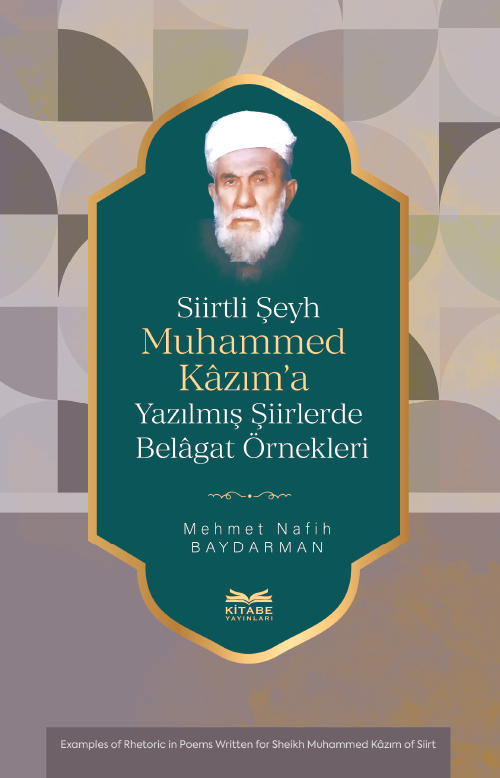
Examples of Rhetoric in Poems Written for Sheikh Muhammed Kâzım of Siirt
This work is a comprehensive study that examines the rhetorical arts found in
Arabic poems written in tribute to Sheikh Muhammed Kâzım, one of the prominent
scholars and spiritual leaders of Siirt. Within the framework of the three
classical branches of Arabic ma‘ānī, bayān and badī‘ the literary devices employed
in poems depicting the life and character of Sheikh Kâzım are analyzed
with meticulous attention.
The study begins with a general overview of Siirt’s historical and cultural fabric,
then explores in detail the city’s rich tradition of poetry and its medrese (Islamic
school) system. The life, education, scholarly identity, and spiritual influence
of Sheikh Muhammed Kâzım are addressed with reference to historical
sources. The poetic works written about him are systematically evaluated in
terms of their formal features, such as poetic forms, meter, and rhyme structure.
The core section of the book is dedicated to the reflections of rhetorical devices
in the poems. A wide range of rhetorical elements—from declarative and imperative
sentence structures to figures of speech like metaphor, simile, and allegory,
as well as stylistic devices such as pun, allusion, irony, and rhyme—are
examined through selected couplets.
This book stands as a valuable resource for researchers interested in Arabic poetry
and rhetoric, offering deep insights into how Sheikh Muhammed Kâzım’s
intellectual and spiritual persona is conveyed through classical poetic expression.
Keywords: Arabic Language; Rhetoric; Qasida; Sheikh Muhammed Kâzım; Poetry
Culture in Siirt

 İÇ SAYFALAR