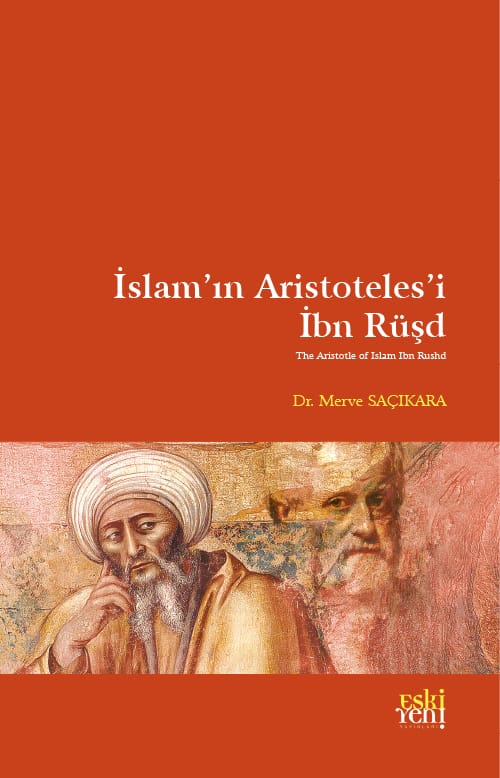
The Aristotle of Islam Ibn Rushd
The This work offers a comprehensive examination of the life, scholarly
contributions, and intellectual legacy of the great Andalusian philosopher
Ibn Rushd (1126–1198). A polymath of the Islamic world, Ibn
Rushd specialized in various disciplines including medicine, mathematics,
philosophy, and Islamic jurisprudence. He is particularly renowned
for his original commentaries on Aristotle, which earned him the title
“The Commentator.”The text explores in detail Ibn Rushd’s contributions to the Peripatetic
tradition through his major, middle, and short commentaries on Aristotle’s
works. Emphasis is placed on his distinctive approach, which, unlike
his predecessors such as al-Farabi and Ibn Sina, engages directly with
Aristotle’s texts in an independent and original manner. His background
as part of a prominent judicial family-often referred to as the “Family of
Judges”-also highlights his significance as a jurist and his influence in
the field of Islamic law.In works such as Fasl al-Maqal, Ibn Rushd defends the harmony between
religion and philosophy, arguing that reason and revelation are not contradictory
but rather complementary. His famous rebuttal to al-Ghazali’s
critique of philosophers, Tahafut al-Tahafut (The Incoherence of the Incoherence),
represents a pivotal moment in the history of Islamic philosophy.
In this text, he revisits fundamental philosophical issues such as
the principle of causality and the debate over the eternity or createdness
of the universe.Ibn Rushd’s thought had a profound impact not only within the Islamic
world but also in the Latin Christian West. His influence on figures
such as Thomas Aquinas and the Latin Averroists attests to his role in
the intellectual awakening of Europe. Despite some of his views being
condemned by the Church, his works were widely read in the West and
helped pave the way for the Enlightenment, contributing to the foundations
of modern philosophy.This study aims to reassess Ibn Rushd’s place in the history of universal
thought in light of his contributions to science and philosophy. With a
timeless intellectual stance, Ibn Rushd remains today an enduring source
of inspiration in the pursuit of reason, freedom, and truth.
Keywords: Ibn Rushd; Aristotle; Reason; Philosophy; Religion

 İÇ SAYFALAR