Numan Bin Sâbit -What is said about Abu Hanifa in the History
of Baghdad-
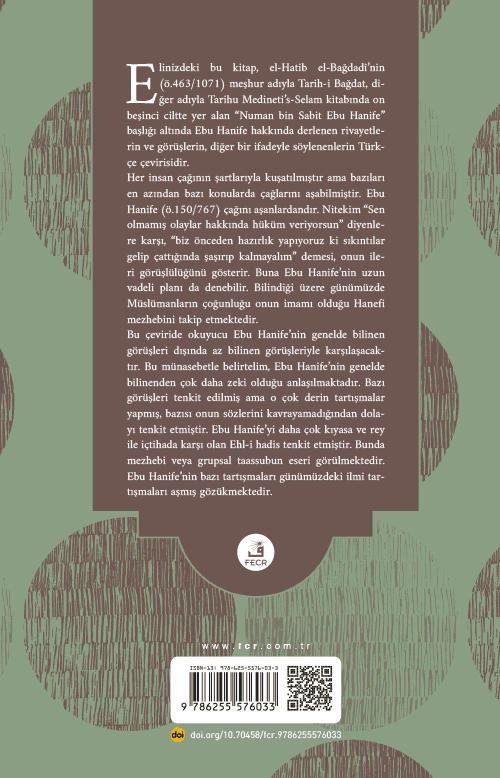
Every person is surrounded by the conditions of their age, but
some have been able to surpass their age at least in some matters.
Abu Hanifa (d. 150/767) is one of those who surpassed their age.
In fact, his saying, “We make preparations in advance so that we
will not be surprised when troubles come” against those who
said, “You are making judgments about events that have not happened”
shows his foresight. This can also be called Abu Hanifa’s
long-term plan. As it is known, the majority of Muslims today
follow the Hanafi school of thought of which he is the imam.
In this translation, the reader will encounter lesser-known views
of Abu Hanifa in addition to his generally known views. In this
connection, we would like to state that it is understood that Abu
Hanifa was much more intelligent than generally known. Some
of his views have been criticized, but he made very deep discussions,
and some criticized him because they could not understand
his words. Abu Hanifa was mostly criticized by the Ahl
al-Hadith, who were against analogy, opinion and ijtihad. The
traces of sectarian or group fanaticism can be seen in this. Some
of Abu Hanifa’s discussions seem to have surpassed current scientific
discussions. Naturally, in the translated text, anecdotal
things about Abu Hanifa’s life are also narrated.
This translation is the Turkish translation of the narrations and
opinions, in other words, the statements, compiled about Abu
Hanifa under the title “Numan bin Sabit Abu Hanifa” in the fifteenth
volume of al-Khatib al-Baghdadi’s (d.463/1071) famously
known as the History of Baghdad, also known as the History
of Medineti’s-Salam. We have also added some footnotes to
the translation. Some of the notes may seem like defense of Abu
Hanifa, but acknowledging the truth is also part of knowledge.
Reaching the truth requires effort. Knowledge has no limits.
Keywords: Abu Hanife; History; Baghdad; Faith; Worship; Opinion;
Jurisprudence; Hadith


 İÇ SAYFALAR