Worships that are fixed by the Sunnah
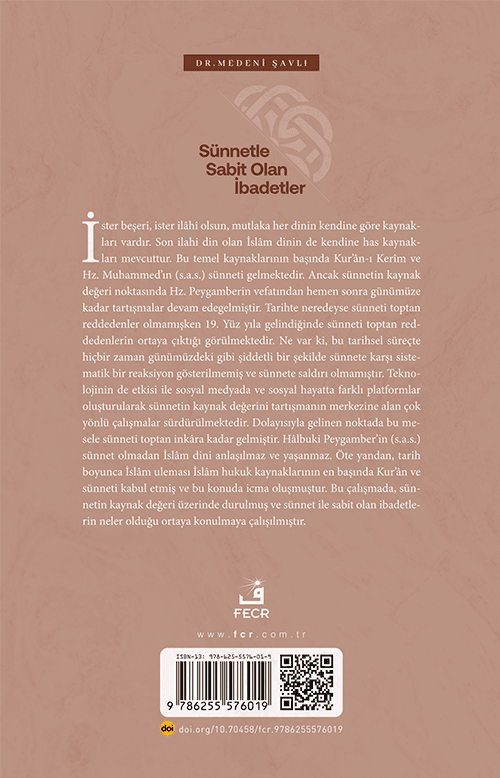
Whether human or divine, every religion has its own sources. The Islamic religion, as the last divine religion, also has its own unique sources. At the forefront of these fundamental sources are the Qur’an and the Sunnah of Prophet Muhammad (PBUH). However, debates regarding the status of the Sunnah as a source have continued from the time of the Prophet’s death until the present day. Although there have never been groups entirely rejecting the Sunnah in history, by the 19th century, those who completely rejected it began to emerge. However, in this historical process, there has never been as intense and systematic a reaction against the Sunnah as we see today, nor has there been such a concerted attack on it. With the influence of technology, various platforms have been created on social media and in society to engage in multifaceted discussions centered around the status of the Sunnah as a source. As a result, the debate has reached the point of total denial of the Sunnah. However, without the Sunnah of the Prophet (PBUH), the Islamic religion cannot be understood or practiced. On the other hand, throughout history, Islamic scholars have accepted the Qur’an and the Sunnah as the primary sources of Islamic law, and a consensus (Ijma) has been established on this matter. This study focuses on the status of the Sunnah as a source and aims to identify the acts of worship that are established through the Sunnah.
Keywords: Islamic law; Worship; Sunnah; Source; Consensus

 İÇ SAYFALAR