Hadith Translation Errors
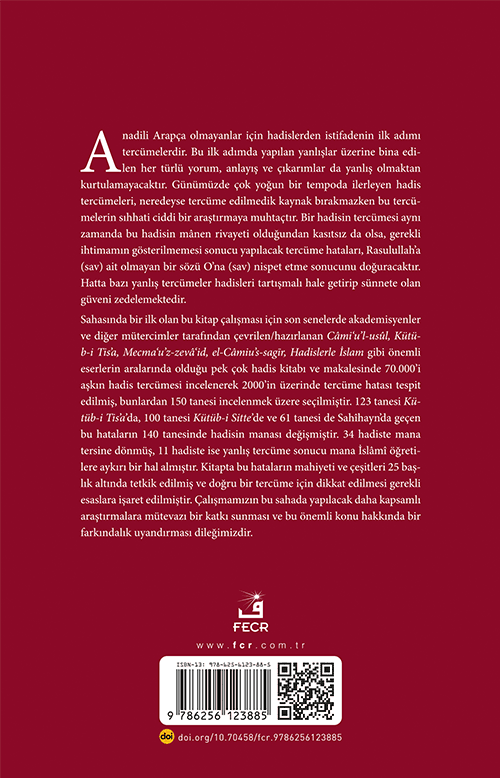
The first step to benefit from hadith for those whose native language is not Arabic is translations. All interpretations and results derived from the mistakes done at this step will inevitably be false. The hadith translations that proceed with great speed nowadays leave very few books not translated; however, the quality of these translations needs serious research. The translation of a hadith is at the same time transmission of its meaning therefore any unintented mistake as a result of lack of attention will result in attributing a sentence to the Prophet (pbuh) which is in fact not His words. Some erroneous translations even make hadith open to discussion and negatively affect the credibility of hadith. In this study which is a first in its field, 70.000 hadith in important hadith books including Câmiʿu’l-uṣûl, Kütüb-i Tisʿa, Mecmaʿu’z-zevâʾid, el-Câmiʿu’ṣ- ṣaġīr and other books and articles have been studied and over 2000 translation mistakes have been detected. 150 mistakes have been selected from these mistakes for this study. 123 of them are in Kütüb-i Tisʿa whereas 61 of them are in Ṣaḥîḥayn. The meaning of 140 hadith has changed due to translation mistakes. The meaning has been reversed in 34 hadith and the meaning in 11 hadith changed such that it became opposite of the teachings of Islam. In this article, the types and nature of these mistakes have been analysed under 25 titles and guidelines have been set forth for a correct translation.
Keywords: Hadith; Translation; Meaning; Interpretation; Translation Mistakes

 İÇ SAYFALAR