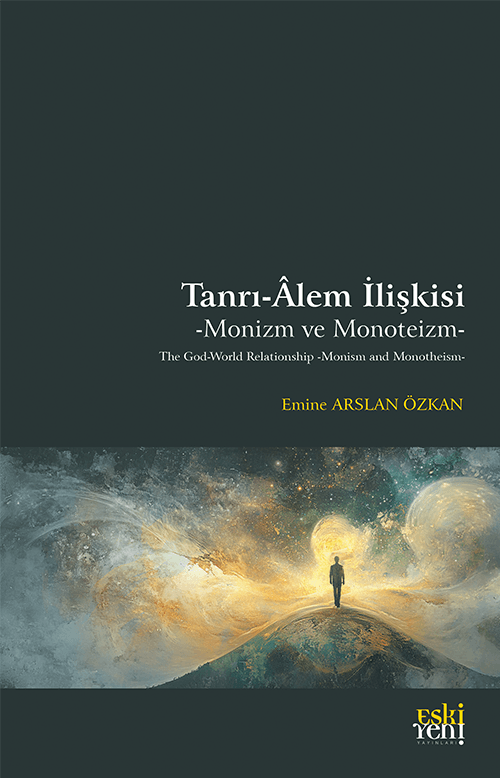
The God-World Relationship -Monism and Monotheism-
In this study, the approaches of monism and monotheism to the God and the world relationship and the concepts of God revealed by this approach are examined comparatively. This study consists of an introduction, two chapters, and a conclusion. In the introduction, the problem related to the causality relationship between God and the world is revealed in the context of monism and monotheism through the discussions of whether there is a reason for the existence of the world. The first chapter focuses primarily on what monism means conceptually within philosophical debates and how it is presented as an ontological thesis with reference to some historical examples. Later, the concepts of God put forward on the basis of monism are explained with reference to the views of three philosophers who have historically embraced monism: Plotinus, Spinoza and Hegel. In this context, first of all, the monistic arguments of the above-mentioned philosophers and the God-world identity views based on this approach are included, and it is concluded that an immanent causal understanding established between God and the world, which is common in these approaches, is insufficient to explain the God-world relationship. In the second chapter, in the context of the God-world relationship of monotheism as opposed to monism, first of all, the conceptual and doctrinal meaning of monotheism is emphasized. For this purpose, firstly, the idea of transcendence, being the main determinant of the God-world relationship in monotheism, is put forward and solutions are sought for the philosophical problems stemming from this idea. Secondly, in monotheism, the immanent dimension of the God-world relationship is defined with reference to the omnipresence and the creativity of God, in a way that does not contradict the idea of transcendence. At this point, the focus is especially on the creation doctrine of monotheism; the immanent dimension of God’s relationship with the world is analyzed in depth through the relationship of creation and will as well as the relationship of creation and conservation, and thus, solutions are sought for the arising problems. As a result, in the context of monotheism, the importance of defining the immanent dimension of the God-world relationship in a consistent manner that would not contradict the transcendence is underlined.
Keywords: Monism; Monotheism; Pantheism; Panentheism; Transcendence; Immanence; Creation.

 İÇ SAYFALAR