Innovation in Arabic Language Teaching
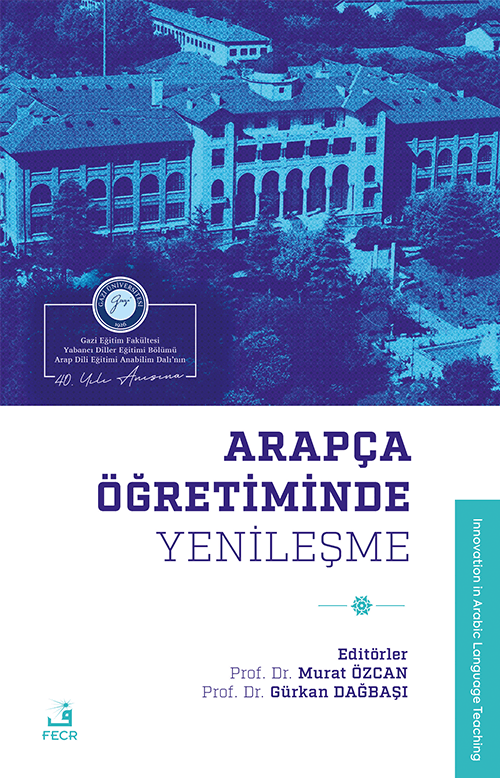
Department of Arabic Language Education within the Faculty of Education at Gazi University was established in 1984. As of 2024, it celebrates its 40th anniversary. To commemorate this milestone, the idea of publishing a book arose. This book not only chronicles the department’s history from its inception to the present but also includes various academic studies conducted by researchers who were once students of the department. The first section of the book features the biographies of current faculty members of the department. The second section explores the historical development of the Arabic Language Education department, examining topics such as teacher training policies, material development methods, employment opportunities, and future perspectives. This is followed by a study that evaluates the academic contributions of the faculty members from its foundation to the present. Statistical analyses of their works are included, offering insights into their academic progression. Subsequently, a bibliometric analysis of master’s and doctoral theses completed under the department is provided. Theses supervised by advisors from the Social Sciences Institute (1984–2018) and the Educational Sciences Institute (1997–present) are categorized as master’s or doctoral studies and presented in chronological order, including student names, years, and thesis titles. Information about the current graduate programs, including courses, admission requirements, quotas, and faculty, is also detailed. This section presents a quantitative analysis of theses by advisors, annual distribution, and thematic classifications. The third section includes various academic studies on Arabic language education and Arabic literature. Highlights include: A Temperament-Focused Approach to Arabic Language Teaching: Enneagram, which aims to provide new perspectives to Arabic educators through Enneagram-based practices. The study combines descriptive analysis of personality types and classroom applications, resulting in sample activities for language teaching. Activity Suggestions and Evaluations for Teaching Culture in Language Learning Based on CEFR 2001 and 2020 Programs, which examines how cultural and pragmatic competence can be integrated into language learning at different levels of the CEFR framework. Criticisms of Taha Hussein’s Mustaqbal al-Thaqafa fi Misr, which presents critiques from nationalist thinker Sati’ al-Husri and Islamic Thinker M. Muhammad Hussein, highlighting the ideological diversity of their perspectives. Science Fiction in 19th and 20th Century Arabic Literature, which discusses the emergence of science fiction as a genre and provides examples of relevant works. Women as a Mirror of Society: An Analysis of ibn Fattumeh’s Journey, which sociologically evaluates female characters in Naguib Mahfouz’s Rihlat ibn Fattumeh, reflecting their societal roles. AI-Assisted Translation Analysis of Arabic Idioms with Stories, which compares AI-based translations (e.g., ChatGPT) with human translations and evaluates them both holistically and in detail. Repetition in Arabic Language, which examines the use and significance of repetition in Arabic discourse. Applications and Recommendations for Effective Use of Artificial Intelligence in Arabic Teaching, which addresses the benefits and challenges of integrating AI technologies into language education. Strengthening the Role of Literature in Arabic Language Teaching, emphasizing the importance of literature for the aesthetic and cultural enrichment of language education. Arabic Lexicography from Past to Present and Its Transformation in the Digital Era, which explores the evolution of dictionaries from traditional to digital formats. Reflections on the Vocational Arabic Course in the Context of Pedagogical Methods and Curriculum Incompatibility, which discusses challenges in Arabic language teaching today. Designing Educational Activities for Arabic Teaching with AI, which explains step-by-step how Arabic teachers can utilize AI technologies in their classrooms. By reviewing the academic contributions of faculty members and tracing the development of Arabic language education over 40 years, the book provides a clear understanding of the field’s growth and outlines a perspective for its future development.
Keywords: Arabic Language Education, Arabic Literature, Innovation

 İÇ SAYFALAR