Ash‘arite Atomism: The Understanding of Substance in Early Ash‘arite Kalām
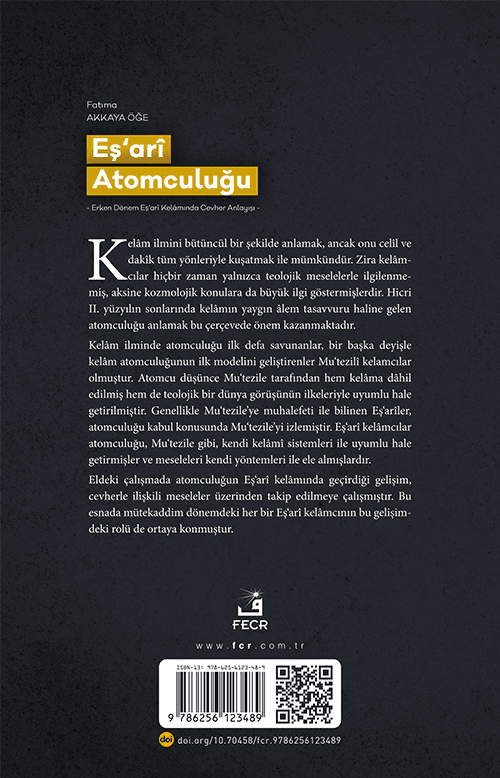
Atomism is a conception of the world seen in different geographies and civilizations before the field of kalām. For this reason, the first part of the study is devoted to the discussions about the origin of the kalām atomism and the views of the most famous atomism models, the Greek and Indian atomist thoughts, especially about the atom. The first chapter, rather than reaching a definite judgment or claiming the origin of kalām atomism, focuses on how atomist theory is used to justify different ideas. Atomism was included in the field of kalām by Mu‘tazila. For this reason, it was Mu‘tazilite mutakallimūn who harmonized the theory with theological principles and developed it with the criticisms directed. For this reason, in the second part of the study, the concept of substance of Mu‘tazila is discussed. Mu‘tazilite mutakallimūn put forward an understanding of substance in harmony with their theological principles. They put forward different views on the definition of substance, its properties, its relationship with accidents, and the nature of constitution the body. Ash‘arite mutakallimūn, who put forward different views on many issues with Mu‘tazila, followed Mu‘tazila in defending the understanding of the universe based on the atomist theory. The theory of atomism in Ash‘arite theology of the mutakaddimūn period has been adopted since Abu’l-Hasan al-Ash‘ari, the sect’s founder. The third part and subject of the study is the concept of substance, which was developed, elaborated, and strengthened by Ash‘arite mutakallimūn. These Ash‘arite mutakallimūn are Imām Ash‘ari, Abū Bakr al-Bāqillānī, Ibn Fūrak, Abū Ishaq al- Isfarāyīnī, Abū Ja’far al-Simnānī, al-Baghdādī, Imām al-Haramayn al- Juwaynī and al-Mutawallī. In this section, which includes the Ash‘ari understanding of substance, this understanding is also compared with the Mu‘tazila and evaluated in terms of the sect.
Keywords: Kalām; Ash‘arite; Atomism; Universe; Substance

 İÇ SAYFALAR