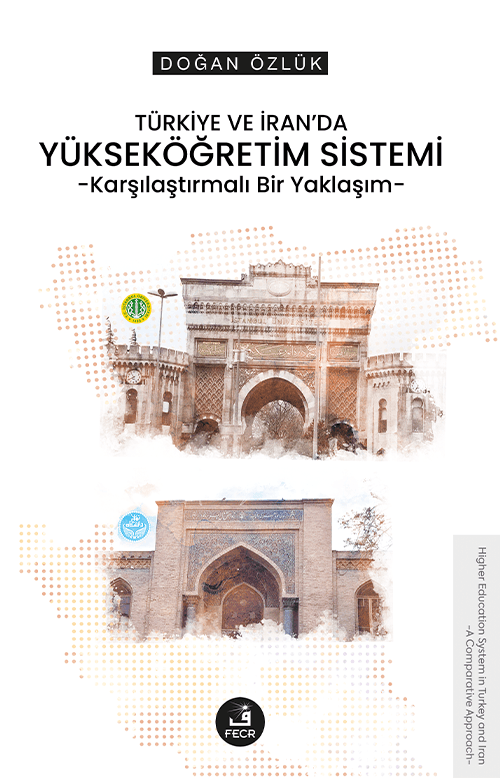
Higher Education System In Turkey And Iran -A Comparative Approach-
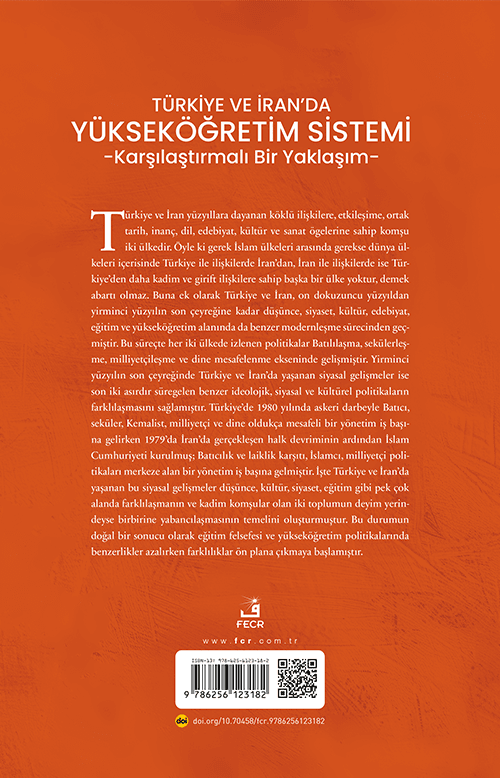
The purpose of this study is to examine the higher education systems of Turkey and Iran using a comparative approach. The document analysis method which is one of the qualitative research methods, was used in the study. The research covers the concepts of higher education in Turkey and Iran, the history, objectives, and structure of higher education, the internationalization of higher education, and the global situation of the higher education systems of both countries.
The study reached the following key findings. Turkey and Iran are two neigh boring countries with deep-rooted relations, interactions, and shared elements of history, religion, language, literature, culture, and art since many centuries. In addition, over the past two centuries (until the 1980s), both countries have experienced a similar modernization process in thought, politics, literature, education, and higher education. However, notable differences in the history of higher education between Turkey and Iran became evident after the political developments that took place in both countries during the 1980s. In Turkey, a military coup in 1980 brought to power a pro-Western, secular, Kemalist, nationalist government that maintained a considerable distance from religion, whereas in 1979, Iran underwent an Islamic Revolution, leading to the establishment of the Islamic Republic. The fundamental principles of the Islamic Revolution are understood to be Islamist, national-conservative, and antiWestern. Consequently, it can be said that, after the 1980s, differences in higher education policies between Turkey and Iran became more pronounced.
The higher education systems in Turkey and Iran share similar objectives, such as raising individuals’ educational levels, developing the country’s capacity in science, research, and technology, serving society, and promoting nationalism. However, while Turkey aimed to build a society that is Atatürkist, secular, Westernoriented, and Kemalist, and distant from religious lifestyles, Iran aims to build a society that adheres to Islamic principles, morality, and values, revealing a divergence in philosophical, intellectual, and ideological goals in higher education.
Certain practices distinguish Iran’s higher education system from Turkey’s, including the involvement of multiple ministries in the higher education process, the absence of vocational school and institute units in university structures, the lack of associate degree programs in open education despite the existence of master’s and doctoral programs, the presence of singlegender universities or units, the inclusion of regional quota programs in the student selection system, additional boosting mark awarded for disadvantaged regions in the student selection system, and the management of medical and health education by a separate ministry.
Based on the findings related to student statistics, it was observed that the proportion of associate degree students to total students is higher in Turkey than in Iran, whereas the proportion of undergraduate, master’s, and doctoral students to total students is higher in Iran than in Turkey. Similar findings were obtained for graduate students. Another finding of the study shows that, overall, the proportion of female students at the associate and doctoral levels is higher in Turkey than in Iran, while the proportion of female students at the undergraduate and master’s levels is higher in Iran than in Turkey. Regarding faculty statistics, the proportion of professors and associate professors to total faculty members is higher in Turkey, whereas the proportion of assistant professors is higher in Iran. In terms of gender-based faculty statistics, the propor-tion of female faculty members in all ranks is higher in Turkey than in Iran.
In this study, the findings related to the internationalization of higher education showed that Turkey is significantly ahead of Iran in terms of both international student and faculty mobility, as well as all other internationalization indicators.
Regarding the findings on scientific publication performance and higher education studies, it was observed that Iran’s performance indicators were generally better than those of Turkey. However, the findings also indicated that the two countries have, overall, similar values.
Keywords: Higher education system, Turkey’s higher education system, Iran’s higher education system, internationalization in higher education, Comparative education

 İÇ SAYFALAR