1000₺ and above purchases FREE SHIPPING
weekday hours 12.00Orders placed up to SAME DAY CARGO

  • 0 Items - ₺0,00
    • There are no items in the cart.
-32%NEW

Original price: ₺440,00.Current price: ₺300,00.

The Psychology of Sacred Time Religiosity

The Psychology of Sacred Time Religiosity

10.70458/fcr.9786258596700

0000-0002-8530-8914 ES0455 ,
The Psychology of Sacred Time Religiosity
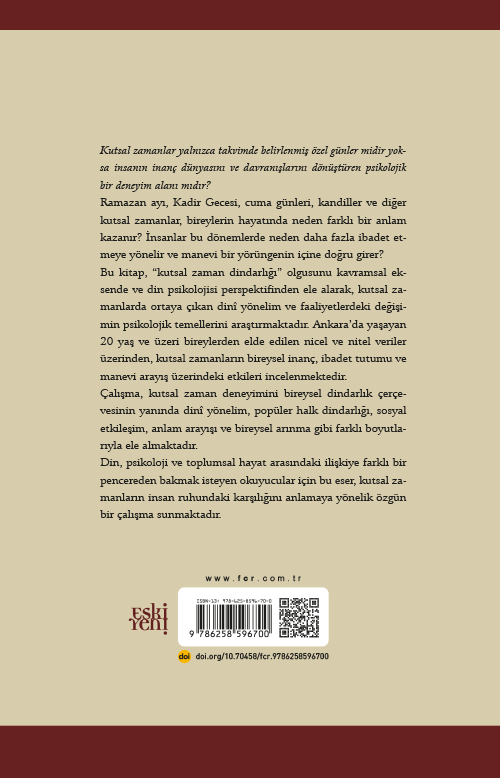
This research aims to examine the impact of sacred time periods on individuals' religious orientations and activities within the context of sociodemographic variables. The primary focus is on determining the level of increase in religious orientation observed during sacred times and the psychological foundations of this increase. Within the theoretical framework, the concepts of "sacred," "time," and "religiosity" are first clarified. Theoretical approaches to the sacred are examined using an eclectic method, focusing on the originist perspective of Leuba, Freud, and Durkheim; the phenomenological perspective of Otto, Eliade, and Cox; the critical approach of Vergote; and the functionalist perspective of Mol and Berger. Subsequently, the effects of the sacred on individual and social life, the fundamental characteristics of sacred time, the understanding of sacred time in Abrahamic religions, popular religiosity, and secular sacred concepts are evaluated. Furthermore, historical and sociocultural factors influencing religious life during sacred times are classified contextually, and some research data from the literature are included in this context. The research methodology encompasses a simultaneous-dominant status, (quantitative-qualitative) qualitative-supported quantitative research model. Structured scales, a personal information form, and closed-ended questionnaires were used in the quantitative data collection process, while qualitative data were obtained through open-ended questions. The sample consisted of individuals over 20 years of age residing in Ankara. Data were statistically analyzed using SPSS software, and qualitative data were evaluated using structural content analysis. The findings indicate a significant overall increase in religious orientation and activities during sacred times. This increase was found to be particularly linked to themes such as the spiritual atmosphere, social interaction, religious reminders, and individual purification motivation. However, some participants expressed the view that sacred times create an environment susceptible to religious manipulation or that a direct link cannot be established between individual belief and time. The type of religious orientation and popular religiosity variables were found to play a mediating role in religiosity during sacred times. In conclusion, sacred times are an important building block shaping individuals' religious orientations, worship attitudes, and spiritual quests. The increase in religious orientation that emerges during these time periods is seen to interact with various psychosocial factors at both individual and societal levels. This research aims to contribute theoretically and empirically to the field by examining the phenomenon of sacred time at the intersection of religious psychology, sociology of religion, and anthropology of religion.
Keywords: Psychology; Psychology of Religion; Sacred; Sacred Time; Religiosity; Religious Orientation; Popular Public Religiosity
 INSIDE PAGES
This study aims to examine the influence of sacred periods on individuals' religious orientations
and religious activities in relation to sociodemographic variables. More specifically,
it seeks to determine the extent of the increase observed in religious orientations during
sacred periods and to identify the psychological foundations underlying this increase.
Within the theoretical framework, the concepts of “sacred,” “time,” and “religiosity” are
first clarified. Theoretical approaches to the phenomenon of the sacred are examined
through an eclectic framework, drawing on the reductionist perspectives of Leuba, Freud,
and Durkheim; the phenomenological perspectives of Otto, Eliade, and Cox; Vergote's critical
approach; and the functionalist perspectives of Mol and Berger. The effects of the sacred
on individual and social life are subsequently examined in relation to the fundamental
characteristics of sacred time, conceptions of sacred time in the Abrahamic religions, popular
folk religiosity, and the concept of the secular sacred. In addition, historical and sociocultural
factors influencing religious experience during sacred periods are thematically
classified, and relevant findings from previous studies are incorporated into the discussion.
Methodologically, the study employs a concurrent mixed-methods research design with
quantitative data given dominant status and qualitative data serving a supportive role.
Quantitative data were collected through structured scales, a personal information
form, and closed-ended survey questions, while qualitative data were obtained through
open-ended questions. The study sample consists of individuals aged 20 and above residing
in Ankara. Quantitative data were statistically analyzed using SPSS, while qualitative
data were evaluated through structural content analysis.
The findings indicate a statistically significant overall increase in religious orientations
and activities during sacred periods. This increase was found to be particularly associated
with themes such as a sense of the hereafter-oriented atmosphere, social interaction,
religious reminders, and individual motivations for spiritual purification. At the same time
time, some participants expressed the view that sacred periods may constitute an area
susceptible to religious manipulation or that no direct relationship can necessarily be
established between individual belief and particular periods of time. religious orientation
and popular folk religiosity were also found to function as mediating factors in sacred-
time religiosity.
In conclusion, sacred periods constitute an important component in shaping individuals'
religious orientations, attitudes toward religious practices, and spiritual quests. the
increase in religious orientation observed during these periods appears to interact with
various psychosocial factors at both the individual and social levels. By examining the
phenomenon of sacred time at the intersection of the psychology of religion, sociology
of religion, and anthropology of religion, this study aims to make both theoretical and
Empirical contributions to the field.
Keywords: Psychology; Psychology of Religion; Sacred; Sacred Time; Religiosity; religious
Orientation; Popular Folk Religiosity
General Publication Number

2039

Brand

Eskiyeni

Brand Number

455

ISBNs

9786258596700

Publication Date

30.10.2026

Log out

Sizes

16 x 24 cm

Baskı Sayısı

1

Page Number

280

Paper Type

70 grams of Enzo

Cover

Update Installments