1000₺ and above purchases FREE SHIPPING
weekday hours 12.00Orders placed up to SAME DAY CARGO

  • 0 Items - ₺0,00
    • There are no items in the cart.
-32%NEW

Original price: ₺220,00.Current price: ₺150,00.

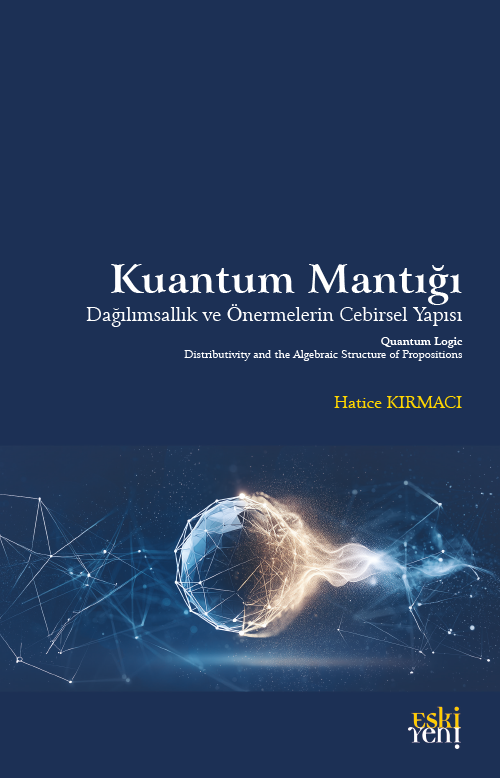
Quantum Logic

0000-0002-2742-1855 ES0448 ,
Quantum Logic
Like many subatomic particles, the question of whether an electron behaves as a particle or a wave remains a subject of investigation. A suitable logic is needed to organize the propositions describing the behavior of such an object at the subatomic scale within a specific form and to construct consistent relationships between them. Quantum logic, which can be considered an interpretation of quantum mechanics, emerged from this need. In classical mechanics, the states and properties of a system are described by the propositions of classical logic based on Boolean algebra. However, in quantum mechanics, the non-commutation of operators representing measured quantities shows that quantum phenomena cannot be described by the propositions of classical logic. A suitable formalization framework is needed for the propositions describing quantum phenomena. In our research, we highlight the various differences between classical and quantum logic, examine the property of distributivity, and consider which algebraic structure quantum logic is suitable for from the perspective of Birkhoff and von Neumann. In our research, all empirical propositions that are logically equivalent to any empirical proposition that it is a physical quality To be able to assert this, we determined that the operators corresponding to the measured quantities must be interchangeable (commutable). Boolean algebra has an algebraic structure that allows for the formalization of classical logic. In such an algebra, the distributive property is satisfied; thus, the distributive property does not pose a problem for classical logic. Consequently, we have determined that the distributive property is not always valid in quantum logic; quantum systems can be modeled through orthomodular lattices associated with closed subspaces of Hilbert space. We believe that this model should evolve with the discovery of new quantum phenomena and that it provides a suitable ground for this evolution.
Keywords: Quantum logic; distributivity; partially ordered sets (posets); lattice; orthomodular lattice; Hilbert space; Boolean algebra.
 INSIDE PAGES
Quantum Logic
Distributivity And The Algebraic Structure Of Propositions
As with many subatomic particles, the question of under what conditions
the electron behaves as a particle or as a wave continues to be the
subject of research. It was necessary to employ appropriate logic to organize
the propositions describing the behavior of such an object at
the subatomic scale into a precise from and to establish coherent relationships
between them Quantum logic, which can be regarded as an
interpretation of quantum mechanics, arise from this need. In classical
mechanics, the state and properties of a system are described using
the propositions of classical logic, which is based on Boolean algebra.
In quantum mechanics, however, the fact that the operators representing
the measured quantities do not commute has shown that quantum
The phenomenon cannot be described using the propositions of classical logic.
It is therefore necessary to have a formal framework suited to the
propositions describing quantum phenomena. In our study, we highlight
the various differences between classical logic and quantum logic,
examine the distributive property and discuss, from the perspective of
Birkhoff and von Neumann, the algebraic structure to which quantum
logic might correspond. At the conclusion of our research, we find that,
in order to assert that all experimental propositions logically equivalent
to a given experimental proposition constitute a physical property,
the operators corresponding to the measured quantities must commute
with one another. Boolean algebra has an algebraic structure that
allows classical logic to be formalized. In such algebra, the distributive
property holds; Thus, distributivity does not pose a problem for classical
logic As a result, the distributive property does not always hold
in quantum logic and quantum systems can be modeled using orthomodular
lattices associated with closed subspaces of Hilbert space. we
believe that this model must evolve in parallel with the discovery of
new quantum phenomena and that it provides a framework conductive
to this evolution.
Keywords: Quantum logic; distributivity; partially order sets (posets);
lattice; orthomodular lattice; Hilbert space; Boolean algebra.
General Publication Number

2020

Brand

Eskiyeni

Brand Number

448

ISBNs

9786258596625

Publication Date

7.10.2026

Log out

Sizes

13,5 x 21 cm

Baskı Sayısı

1

Page Number

123

Paper Type

70 grams of Enzo

Cover

Update Installments